
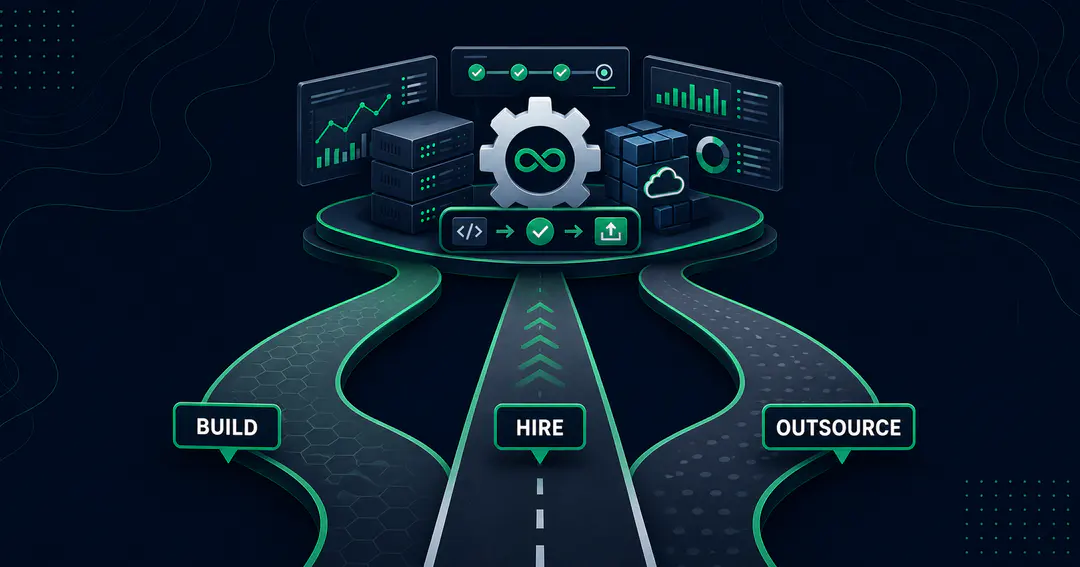
Summary: Not every team needs a dedicated platform team. If yours does, the right way to resource it is a deliberate choice, not a default. Build in-house when platform work is continuous and core to your product. Use staff augmentation when you own the architecture and need senior hands fast. Outsource to a DevOps partner when you need cloud and Kubernetes expertise you do not have and cannot justify hiring full-time for what is really a part-time need. Whichever path you take, judge a partner on operational depth, honest scoping, and observability, the piece most teams underinvest in until an incident forces the issue.
Most conversations about DevOps start in the wrong place. They start with "we need Kubernetes" or "we need an SRE," when the first question is whether you need a dedicated platform capability at all, and if so, how to resource it. Getting that decision wrong is expensive in both directions. Over-invest and you are paying senior engineers to babysit infrastructure that a managed service would handle. Under-invest and your product engineers spend their week fighting deployments instead of shipping. This is a decision framework for getting it right, aimed at engineering and IT leaders rather than at the tooling.
First, Do You Actually Need a Dedicated Platform Team
The honest answer for many teams is not yet. If a managed platform and a good CI/CD pipeline are carrying you, and your product engineers are not routinely blocked on infrastructure, adding a dedicated platform function may be solving a problem you do not have. The signals that you do need one are concrete:
- Deployments have become a bottleneck.
- Your cloud bill is growing faster than your usage, in ways nobody can fully explain.
- Reliability incidents are recurring.
- Your Kubernetes footprint has outgrown the one engineer who quietly understands all of it.
Cost is often the forcing function, and it is worth looking at seriously before you decide, because a lot of platform spend is waste rather than need. The patterns in our Kubernetes cost optimization write-up frequently reveal that the problem is not too little platform investment but poorly tuned infrastructure. Diagnose the actual bottleneck before you resource against it, because "hire an SRE" is an expensive answer to a problem that might be a misconfigured autoscaler.
Option One: Build an In-House DevOps Team
Building in-house makes sense when platform work is continuous, deeply tied to your product, and central enough that you want the knowledge to live permanently with your team. A payments company or a large multi-tenant SaaS has platform concerns that never stop, and owning that capability is the right call.
The honest costs are the ones teams underestimate. Senior platform and SRE engineers are among the hardest and slowest hires in the market, often six months to land the right one, and once hired they need enough steady-state work to stay engaged. The complexity is real too: something like Kubernetes multi-tenancy is not a weekend project, and a single in-house hire who becomes the only person who understands your cluster is a bus-factor risk you have simply moved in-house rather than removed. Build when the work is permanent and you can staff it with more than one person. Otherwise you are creating the same single-point-of-failure you were trying to avoid.
Option Two: Hire DevOps Engineers Through Staff Augmentation
Staff augmentation fits when you already own your platform architecture and direction but need more senior hands, faster than a full-time hiring cycle allows. You keep technical control, the engineers work under your direction and inside your standups, and you scale capacity up or down without the permanence of headcount.
The thing that makes or breaks this model is whether the knowledge stays with you. Augmented engineers who operate as true extensions of your team, documenting as they go and transferring what they know, leave you stronger. Ones who operate as a black box leave you dependent. The distinction is the same one that decides any embedded engagement, and it is worth being explicit that knowledge transfer is a deliverable, not a nicety, before anyone starts.
Option Three: Outsource to a DevOps Consulting Partner
Outsourcing to a partner fits the most common case: you need real cloud and Kubernetes expertise, you need it now, and the work is genuinely part-time or project-shaped, so a full-time senior hire is both slow and poorly used. A good partner brings reference architectures, battle-tested patterns, and day-two operational experience your team would take years to accumulate.
The risk is the well-worn agency failure mode: a partner that sets up your infrastructure, hands you a diagram, and leaves you unable to operate it. The right partner does the opposite, building runbooks, operating procedures, and enablement so your team can run the platform confidently after they step back. When you evaluate outsourcing, the question is not just "can they build it" but "will we be able to run it without them," which is the same ownership standard we apply to a backend built with an external team.

What to Look For in a DevOps and Kubernetes Partner
Across the hire and outsource paths, a few things separate an engineering partner from a body shop. The first is operational depth, evidence they have run this in production and dealt with day-two reality, not just stood up a cluster once. Ask for the incidents, the failure modes, the things that broke, because the war stories are where the real experience shows.
The second, and the most counterintuitive, is the willingness to tell you that you do not need something. A partner who talks you out of a service mesh you do not need is worth more than one who installs it to look sophisticated, and our piece on whether you actually need a service mesh exists precisely because so many teams adopt that complexity prematurely. The cloud and Kubernetes ecosystem, catalogued by the CNCF landscape, is vast, and a good partner helps you use less of it, not more. Complexity you do not need is complexity your team pays to maintain.
Don't Underinvest in Observability
Whichever path you choose, observability is the piece teams consistently underfund until an incident makes the case for them. You cannot operate what you cannot see, and a platform without solid monitoring, alerting, and enough retained history to investigate a problem is a platform that will surprise you at the worst possible time. This is foundational, not advanced, work, and a production-grade Prometheus monitoring stack is the baseline to hold yourself or a partner to.
It is also an area where the right setup pays for itself. Once your metrics history matters for capacity planning and incident forensics, long-term storage becomes its own discipline, and running it across more than one cluster is a step change again. Our write-up on Thanos in multi-cluster production is an honest account of what breaks at that point, and it is a fair depth to expect from anyone claiming operational maturity.
Whether you build or partner, treat observability as a first-class part of the platform rather than something to add after the first outage. That long-horizon metric storage is exactly the ground our Thanos long-term storage work covers.
Red Flags When You Outsource DevOps
A handful of signs tend to show up before an engagement goes wrong. The clearest is a partner that leads with tools and buzzwords rather than asking about your workload, because a shop selling Kubernetes has an incentive to see every problem as a Kubernetes problem. Another is the setup-and-vanish model: infrastructure delivered with no runbooks, no enablement, and no plan for your team to operate it.
Watch for a refusal to consider simpler solutions, and for anyone who cannot show you day-two operational experience as opposed to a one-time build. And be wary of a partner that keeps the knowledge to itself, because in platform work more than anywhere, a vendor who is the only one who understands your infrastructure is a dependency you will find very expensive to unwind.
DevOps: Build, Hire, or Outsource, the Short Version
Start with whether you need a dedicated platform capability at all, and diagnose the real bottleneck before you resource against it. From there:
- Build in-house when the work is continuous and you can staff it with more than one person.
- Hire through staff augmentation when you own the direction and need senior hands fast.
- Outsource when you need expertise you cannot justify hiring full-time.
Whichever path you pick, judge a partner on operational depth, honest scoping, and a commitment to leaving your team able to operate what they built. And fund observability regardless, because it is the difference between running your platform and being surprised by it.
This is how we run DevOps and platform engagements: your team's ability to operate the result is the goal, not a footnote. See how we work on Kubernetes consulting and platform team enablement, or follow our engineering work on LinkedIn.
Frequently Asked Questions
Do I need a dedicated DevOps or platform team?
Not always. If a managed platform and a solid CI/CD pipeline are carrying you and your product engineers are not routinely blocked on infrastructure, you may not need a dedicated function yet. The signals that you do are concrete: deployments have become a bottleneck, cloud costs are growing unexplained, reliability incidents recur, or your Kubernetes footprint has outgrown the one person who understands it. Diagnose the real bottleneck first, because the answer is sometimes a configuration fix rather than a new hire.
Should I build an in-house DevOps team, hire through staff augmentation, or outsource?
Build in-house when platform work is continuous, core to your product, and you can staff it with more than one person. Use staff augmentation when you own the architecture and direction but need senior hands faster than a full-time hire allows. Outsource to a DevOps partner when you need cloud and Kubernetes expertise you do not have and the work is genuinely part-time or project-shaped. In every case, insist that knowledge transfer is a deliverable.
What should I look for in a DevOps consulting partner?
Operational depth (real day-two experience, not a one-time build), honest scoping (a partner who tells you when you do not need something like a service mesh), runbooks and enablement so your team can operate the platform afterward, and strong observability. Avoid partners who lead with tools rather than your workload, or who set up infrastructure and leave you unable to run it.
Why does observability matter so much in a DevOps engagement?
Because you cannot operate what you cannot see. A platform without solid monitoring, alerting, and enough retained metric history to investigate an incident will surprise you at the worst time. Treat a production-grade monitoring stack, and long-term metric storage once history matters, as a first-class part of the platform rather than something to bolt on after the first outage.
Procedure Team
Engineering Team
Expert engineers building production AI systems.