
Most framework debates have a clear winner and a clear loser. One option gets faster, cheaper, or better maintained, and teams stop seriously considering the other.
Flutter and React Native have not followed that pattern. Both are production-ready, both are actively maintained by large engineering organizations, and both are running at scale across some of the apps most engineers use every day: Instagram, Shopify, and Microsoft Teams on the React Native side; BMW's connected car app, Google Pay, and eBay Motors on the Flutter side. After years of competition, they have settled into something different: two mature frameworks that have made fundamentally different architectural bets, and stopped competing on the same dimension.
That is actually harder to reason about than a clear winner. When both work, the question shifts from "which is better" to "which is right for us," and that is a harder question to answer.
This is an attempt to make that question easier. Not by picking a winner, but by laying out what each framework has actually bet on, and giving you a structure to figure out where your product and your team fall.
Two Frameworks That Stopped Racing Each Other

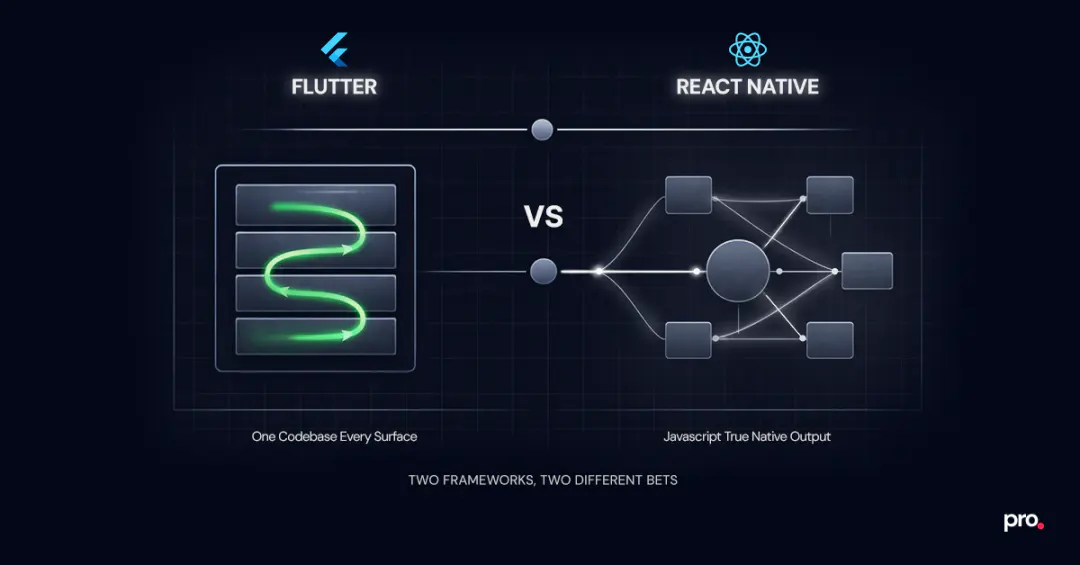
The most useful thing to understand about cross-platform mobile development today is that Flutter and React Native are no longer optimizing for the same thing.
Flutter made a bet on ubiquity. The goal is to be the single UI toolkit a team uses regardless of what surface the product runs on: mobile, web, desktop, embedded hardware. Google built a custom rendering engine for this. They own the language (Dart), control the entire stack, and have a roadmap that extends well beyond phones.
The Impeller engine draws every pixel independently of the platform, which means a Flutter codebase does not care whether it is running on iOS, Android, a web browser, or a car dashboard. That consistency is the point.
React Native took a different bet entirely. Rather than abstracting away the platform, React Native development leans into the platform itself. The New Architecture, which is now the default for all new projects, uses the Fabric renderer and TurboModules to render actual native platform components.
An iOS button is a real UIView. An Android ripple is a real Android View. The framework sits as close to the platform as it can while letting teams write in JavaScript and TypeScript. Meta runs it across Facebook, Instagram, and Messenger at a scale most teams will never encounter.
Neither bet is obviously wrong. They reflect genuinely different views on what cross-platform mobile development should look like. Understanding this divergence is the starting point for every other consideration.
How React Native's New Architecture and Flutter's Impeller Changed the Game
React Native's New Architecture and Flutter's Impeller engine are the two most significant technical shifts in cross-platform mobile development in the last few years (linking to official docs: New Architecture, Impeller), and most of the older discourse predates both of them.
The React Native bridge that caused jank and latency has been replaced. The Flutter shader compilation stutter that made animations uneven on first launch has been fixed. Both frameworks shipped architectural overhauls, and production behavior today is meaningfully different from what teams experienced three years ago.

React Native's New Architecture does three things that matter:
- Fabric renderer: Layout now processes synchronously on the UI thread, removing the asynchronous delay that caused animation issues in older versions.
- TurboModules: Lazy-loaded, type-safe access to native APIs without bridge overhead. Native calls that used to queue up now happen directly.
- React 19 alignment: Teams using React on the web can bring that knowledge directly into mobile without a context switch. The mental model is the same.
Flutter's side of this is the Impeller engine, which replaced Skia and solved the pre-compilation problem that affected earlier versions. Shaders are pre-compiled into the engine itself, so there is no stutter on first render. The rendering behavior is now consistent and predictable across hardware.
For most production apps, both frameworks deliver smooth 60fps that users cannot distinguish from native. Animation-heavy interfaces and pixel-perfect branded UIs still favor Flutter because it controls every pixel and does not depend on what the platform decides to render.
Apps where native platform feel matters, such as those where users expect iOS scroll physics or Android component behavior, still favor React Native because it uses actual platform components rather than simulating them.
Both frameworks are in a different place from where the older discourse was anchored. Any decision based on benchmarks from three or more years ago is working from outdated information. The language question, covered next, is now the more consequential variable for most teams.
Once you understand what each framework has fixed, the next question is who is going to build with it.
Dart or JavaScript: The Language Decision Is Really a Team Decision
The Dart vs JavaScript choice is not a syntax preference. It determines who you can hire, how long it takes to onboard a new engineer, and how much leverage your existing team has on day one.
React Native uses JavaScript and TypeScript. For teams that come from a React background, whether web frontend, full-stack, or previous mobile work, the transition is short. The component model is familiar, the tooling is familiar, and the mental model for state management carries over. A capable JavaScript developer can be contributing meaningfully to a React Native codebase within days.
Flutter development uses Dart. Dart is well-designed: strongly typed, compiled to native code for production, with excellent hot reload during development. The language is not difficult to pick up. But it is a skill that requires deliberate investment. A developer who has not worked with Flutter before has a real ramp-up period ahead of them, and in a deadline-driven context, that cost is concrete.
How much this matters depends on your team's situation:
- Your team already has depth in one framework: This usually settles it. The compounding value of institutional knowledge: the debugging shortcuts, the patterns, the prior context, is real and does not show up in any comparison table.
- You are hiring externally: The available talent pool strongly favors React Native. JavaScript is the most widely used language in the world, and the overlap with web and full-stack engineers is significant. Flutter's developer community is growing fast, per the Stack Overflow 2025 Developer Survey, but the absolute number of engineers who can join a Flutter codebase on short notice is smaller in most markets.
- You are working with a development partner: The global market matters less here. What matters is whether the partner has genuine depth in the framework you choose.
Dart is not a barrier. Plenty of teams have learned it and become productive quickly. But the ramp-up is real, and it should be an explicit variable in your timeline, not something to figure out once the project has started.
With the language question clear, the next step is matching those signals to the situations where each framework is the better call.
Picking the Right Mobile Framework for Your Situation
The right mobile framework for your situation depends on two things working together: what your product needs from the UI layer, and what your team can execute without a costly ramp-up. Run through both columns and see where the signals land.
Choose Flutter when:
- UI design consistency is a core product requirement, not just a style preference. Consumer fintech, branded apps, anything where designers specify exact visual behaviour across every screen.
- Your roadmap includes web, desktop, or embedded surfaces in the next 18 months. Flutter's architecture makes that expansion significantly cheaper to plan for from day one.
- The app is animation-heavy or visually complex. Flutter controls every pixel and does not depend on what the platform decides to render.
- Your team already has Dart or Flutter experience. Institutional knowledge compounds. Do not pay ramp-up cost twice.
- You are building greenfield with a design-first product and have the flexibility to choose the stack from scratch.
Choose React Native when:
- Your team is already strong in JavaScript and React. The component model, tooling, and mental model transfer directly. A capable JavaScript developer can contribute within days.
- The app needs to feel exactly native on each platform. iOS bounce physics, Android ripple effects, and platform accessibility patterns come without extra work.
- You are adding cross-platform capability to an existing native codebase. React Native has more mature brownfield tooling and better-documented integration patterns.
- You need to hire from a broad developer pool quickly. JavaScript's talent pool is significantly larger in most markets.
- You are already on a React Native codebase. Upgrade to the New Architecture first. The gap that motivated most migration discussions has closed, and a full rewrite carries high cost for limited gain.
Most real situations involve signals from both columns. One framework will usually come out ahead across the signals that matter most for your specific context. When both columns feel equally balanced, that is a useful signal in itself: both frameworks would work, and the call should go to whatever your strongest mobile engineer prefers.
We have shipped production apps in both Flutter and React Native across fintech, healthcare, and SaaS products. The table above reflects patterns we see repeatedly, not just benchmark comparisons. If you are mid-decision and want a second perspective before committing to a direction, we are easy to reach.
One more option worth naming before you commit: Kotlin Multiplatform. It is not a Flutter or React Native replacement, but some situations genuinely fit it better. KMP shares business logic across platforms, such as networking, data models, API calls, and local caching, while keeping the UI entirely native on each platform.
For teams with mature native codebases who want to reduce logic duplication without a full cross-platform rewrite, it is a more conservative path than either framework. For teams building from scratch who want a single UI codebase, it is not the right tool. If your primary pain is duplicated business logic rather than duplicated UI development, it is worth a brief evaluation before committing to either framework.
How to Choose Between Flutter and React Native
Choosing between Flutter and React Native gets clearer when you work through four questions in order, rather than trying to weigh every tradeoff at once.
What does your team already know? Existing depth in Dart or JavaScript is the default starting point unless there is a clear technical reason to override it.
What does the product actually need from the UI layer? Custom, brand-controlled interfaces favor Flutter. Native platform feel and standard component behavior favor React Native.
Are you hiring, growing an existing team, or working with a partner? This changes how much the talent market weighs into the call, as covered in the language section above.
Where is the platform roadmap going in the next 18 months? Multi-platform ambitions beyond just mobile favor Flutter's architecture. Deep native integration or extending an existing codebase favors React Native.
In most cases, one or two of these questions will cut through the ambiguity. The remaining decisions tend to become obvious once the primary constraints are clear.
The choice between Flutter and React Native is rarely the wrong choice in either direction. Teams have shipped great mobile apps with both. What makes the difference is not the framework itself but whether the decision was made with clear reasons, matched to the actual constraints of the product and the team.
Pick one because it fits your situation, write down why, and the framework becomes a foundation you can build on. Pick it by default, and you will be revisiting the question at the worst possible time.
Both frameworks are good. The question was never which one. It was always which one for you.
Frequently Asked Questions
Is Flutter better than React Native in 2026?
Neither is universally better. Flutter is the stronger choice when UI consistency across multiple platforms is a core requirement, or when the product roadmap extends beyond mobile. React Native is the stronger choice for JavaScript teams, apps that need native platform feel, or projects extending an existing codebase. The right answer depends on your product and team, not on a general ranking.
Should I migrate from React Native to Flutter in 2026?
For most teams, no. React Native's New Architecture has addressed the main technical issues, including performance, animation quality, and bridge latency, that historically motivated Flutter migrations. Unless your product has a specific rendering requirement that Flutter solves and React Native cannot, the rewrite cost is high relative to the gain. Upgrading to the New Architecture is the better first step for teams on older React Native versions.
Is Flutter harder to learn than React Native?
Flutter uses Dart, which requires deliberate investment from developers who have not used it before. React Native uses JavaScript and TypeScript, which most web and full-stack engineers already know. For a team without prior Flutter experience, React Native has a shorter onboarding path. That said, Dart is a well-designed language and teams that commit to it typically find the ramp-up faster than expected.
Can Flutter replace React Native?
For some teams and products, yes. For others, no. Flutter's multi-platform architecture and pixel-perfect UI control make it the better fit for certain product types. But React Native's native rendering and JavaScript ecosystem make it the right tool in situations where Flutter is not. The two frameworks are increasingly solving different problems rather than competing for the same use cases.
Which framework is better for enterprise mobile apps?
Both are used in enterprise production at scale. Flutter powers BMW's connected car app, eBay Motors, and Google's own products. React Native powers Facebook, Instagram, Shopify, and Microsoft Teams mobile. The enterprise decision comes down to the same factors as any other: team skills, UI requirements, platform roadmap, and integration complexity, not the enterprise credentials of either framework.
We have built and scaled mobile apps across fintech, healthcare, and enterprise SaaS in both frameworks. If your team is mid-decision, check how we work with Flutter App Development and React Native Development and feel free to reach out if you want a second opinion before committing to a direction.
Procedure Team
Engineering Team
Expert engineers building production AI systems.