
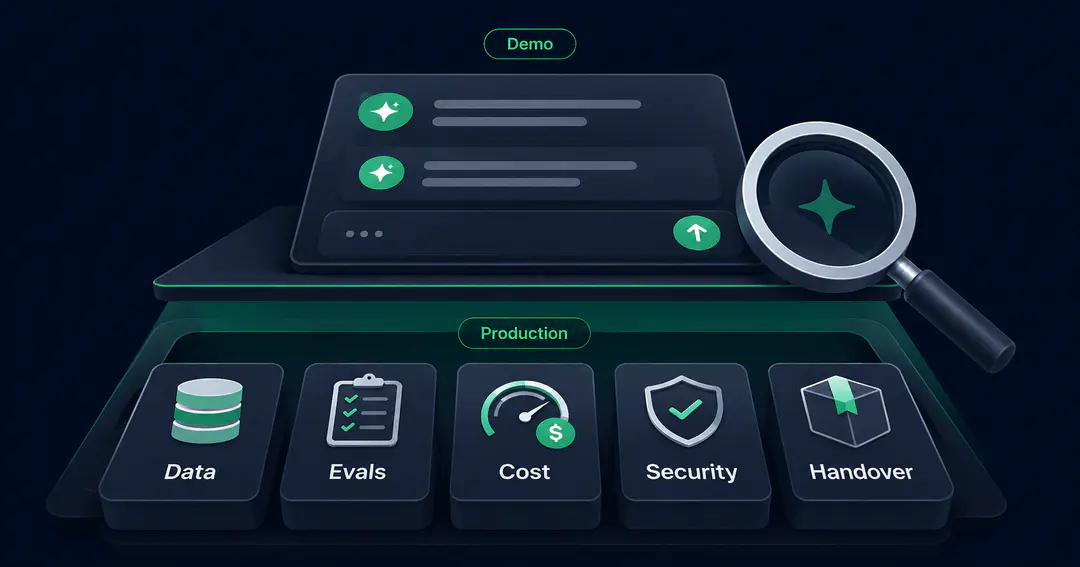
Summary: Any team can build an AI demo, and the demo is the easy 20 percent. Production AI engineering is the 80 percent the pitch never shows: evaluation harnesses that prove the system works, data and retrieval pipelines, cost and latency control, security against prompt injection and data leakage, and observability. When hiring an AI engineering team, judge them on how they measure whether the AI actually works, how they handle cost and failure at scale, how they secure it, and whether your team can own the system afterward. Not on the demo.
A capable engineer with an LLM API and a weekend can put something in front of you that looks like magic. It answers questions, it summarizes documents, it sounds confident. The room is won. And that ease is the problem, because none of it tells you whether the same team can build a system that still works next quarter, under real load, on your data, without quietly costing a fortune or leaking something it should not. That gap, between the demo that wins the meeting and the system that survives production, is what this piece is about.
The uncomfortable truth is that the model is maybe 20 percent of the work. The other 80 percent is the part nobody demos:
- Getting your data into a usable state
- Building the retrieval and pipelines around the model
- Measuring whether the output is actually right
- Controlling cost and latency
- Securing the system against attack and leakage
- Keeping it observable once real users touch it
A team that only shows you the 20 percent has either not done the 80, or is hoping you will not ask. This is the same production-first standard we hold on our own Python and AI engineering work, and it is the lens to bring to anyone you are evaluating.
Why the Demo Is the Easy 20% of AI Engineering
A demo runs once, on inputs the builder chose, with nobody adversarial in the room. Production runs thousands of times a day on inputs you did not anticipate, from users who will paste in nonsense, edge cases, and the occasional attack. The behaviors that make a demo shine, a clever prompt, a curated example, a happy path, are exactly the behaviors that hide how the system fails when it meets reality.
So the first mental shift when hiring is to stop being impressed by the demo and start asking what happens around it. Four questions do most of the filtering:
- What does this do when the input is garbage?
- What happens when the model is having a slow day?
- What happens when ten thousand people hit it at once?
- What happens when someone tries to break it on purpose?
A team that has shipped AI to production answers all four fluently, because it has been burned by all four. A team that has only built demos goes quiet, or waves at the model as if the model were the hard part.
What a Strong AI Engineering Team Does That a Demo Won't Show
The work that separates production from a prototype is unglamorous, and it is where the real engineering lives. Two layers carry most of it.
1. The data. Most AI projects that stall do so not because the model is wrong but because the data feeding it is messy, incomplete, or not actually available in the shape the system needs. A strong team spends real time here before it spends any time on prompts, and it is honest with you when your data is not ready.
2. The system around the model. Retrieval that surfaces the right context. Orchestration that chains steps reliably. Fallbacks for when a call fails. The plumbing that turns a clever response into a dependable feature. If you are building anything agentic, this is most of the work, and it is worth understanding what AI agents actually do under the hood before you evaluate a team's claims about them.
A team that has shipped talks about this scaffolding readily. A team that has only demoed treats the model as the product and the scaffolding as an afterthought.
Evaluation Discipline: Can They Prove the AI Works?
Here is the single question that separates a serious AI team from a hopeful one: how do you know it works? With ordinary software, you write a test, it passes or fails, and you move on. AI is not deterministic. The same input can produce different outputs, and "looks good to me" does not scale past a handful of examples. A team without an evaluation strategy is flying blind, and it will not know when a prompt change or a model update quietly breaks something for a slice of your users.
A strong team has an evaluation harness. Three parts, none of them optional:
- A golden set. Representative cases drawn from the inputs that actually matter to your business, not the three that demo well.
- A scoring method. Some way to turn an output into a number, so quality is comparable across runs instead of argued about.
- A habit of running it. On every prompt change, model upgrade, and retrieval tweak, before it ships.
That is what lets them tell you their accuracy on the cases that matter, rather than showing you three that went well. This is the discipline we wrote about in our guide to testing LLM systems in production, and it is the first thing to probe for. Ask how they would measure whether the AI is doing its job. If the answer is a shrug or a vibe, that is your answer about the team.
Cost and Latency: What Separates Production From a Prototype
A demo's economics are irrelevant because it runs a few times. In production, every call costs money and time, and the naive version of a system can be an order of magnitude more expensive than it needs to be. A team that has operated AI at scale pulls four levers, and can name all four without prompting:
- Model routing. Which model handles which task, and where a smaller, cheaper one is genuinely enough.
- Caching. Not paying twice for work the system has already done.
- Context discipline. Sending the model what it needs and nothing more, since every extra token is billed on every call.
- Latency budgets. Keeping response time under the threshold where users quietly abandon the feature.
This is not a detail to sort out later. Token costs and the failure patterns that inflate them are structural decisions, and we have written up the real token costs and failure patterns that catch teams out. Ask a candidate team how they would keep the system affordable at ten times the current traffic. A production team has a concrete answer involving model selection, caching, and measurement. A demo team has not thought about it, because a demo never sent them the bill.
AI Security: What to Look For Beyond the Model
AI systems have a threat surface that traditional software does not, and it is the part most teams underestimate. Three risks show up on almost every real deployment:
- Prompt injection. A user or a document manipulates the model into ignoring its instructions. This is not hypothetical, it is a routine attack.
- Data leakage. Sensitive information ends up in a model's context, its output, or a third party's logs.
- Supply chain. The moment you use third-party tools, models, or agent components, you inherit code and behavior you did not audit.
These map directly onto the OWASP Top 10 for LLM Applications, which is the shared vocabulary any serious AI team should already be fluent in.
A team worth hiring treats these as first-class, not as something to bolt on after launch. They can talk about how they guard against prompt injection, how they keep sensitive data from ending up in a model's context or output, and how they vet the components they pull in. We have written specifically about the prompt injection and supply chain risks in agent systems, and how a team answers on security tells you whether they have actually run AI where it can be attacked. If security only comes up because you raised it, that is a flag.
Red Flags When You Hire AI Engineers
Some patterns show up again and again in teams that later disappoint:
- The demo is the whole pitch. They lead with the model and go quiet on everything around it. No evaluation story, no cost story, no security story.
- Hype fluency without production scars. They talk confidently about the latest technique but have no answer for what happens when it fails at 3am.
- AI as the answer to every question. A vendor whose whole business is AI has every reason to frame your problem as one.
- Opacity. They cannot explain a decision in plain terms, or they resist your engineers reviewing the work.
The third flag has a useful flip side. If a team tells you your problem does not need AI at all, that a plain rules-based system will do the job better and cheaper, they are talking themselves out of a bigger invoice to give you a straight answer. That is a team worth hiring, not one to cross off.
The fourth is simpler than it sounds. When a vendor cannot explain a choice in plain English, or gets uncomfortable about your engineers reading the code, it is usually one of two things: the system is more fragile than the demo suggested, or they would rather you could not run it on your own.
How to Evaluate an AI Development Company Before You Commit

The evaluation is mostly a conversation, and the right questions do the filtering. Ask them to walk you through an AI system they took to production and what broke on the way, because what broke and how they fixed it is where the real experience shows. Ask how they measure whether it works, how they keep it affordable, and how they handle prompt injection and data leakage. Ask what happens to the knowledge when the engagement ends.
That last question matters as much in AI as anywhere, and it is the same standard we apply on a backend engagement with an external team. You are not buying a demo. You are buying a system your team can run, extend, and trust after the builders have moved on. The teams worth hiring have thought about all of this because they have lived it. The teams to avoid have a great demo and a quiet answer to every question that comes after it.
Hiring an AI Engineering Team: The Short Version
The demo is the easy 20 percent, and grading it tells you little. Judge an AI engineering team on the 80 percent that decides whether the system survives production: a real evaluation harness that proves it works, honest handling of your data, cost and latency control at scale, security against prompt injection and leakage, and a handover that leaves your team able to own it. A team that leads with all of that, and sometimes tells you not to use AI at all, is the one worth hiring.
This is how we build AI at Procedure: production-grade from the first commit, with the hard 80 percent treated as the actual work, not a slide in the pitch. See how we approach AI engineering, or follow our engineering work on LinkedIn.
Frequently Asked Questions
How do I evaluate an AI engineering team before hiring?
Look past the demo. Ask them to walk through an AI system they took to production and what broke on the way, ask how they measure whether the output is actually correct, ask how they control cost and latency at scale, and ask how they handle prompt injection and data leakage. A team that has shipped AI answers all of these fluently. A team that has only built demos goes quiet after the model.
What is the difference between an AI demo and production AI?
A demo runs a few times on inputs the builder chose, with nobody adversarial present. Production runs constantly on unpredictable real-world inputs, under cost and latency constraints, exposed to attack. The model is roughly 20 percent of production work; the other 80 percent is data, evaluation, cost control, security, and observability, none of which a demo exercises.
Should I hire an AI development company or use staff augmentation?
It comes down to who owns the architecture. A development company or pod owns the outcome: it delivers a working AI system and brings its own judgment about evaluation, cost, and security, which fits teams that want to hand off the problem. Staff augmentation is the reverse, embedding AI engineers under your technical direction, which fits teams that already own the architecture and just need senior capacity quickly. Either way, make evaluation, security, and knowledge transfer explicit deliverables rather than assumptions.
What are the biggest red flags when hiring AI engineers?
Leading with the model and the demo but going quiet on evaluation, cost, and security; hype fluency with no production scars; reaching for AI where a simpler system fits better; and resistance to your engineers reviewing the work. None of these show up in a demo, and all of them show up in a serious technical conversation.
Procedure Team
Engineering Team
Expert engineers building production AI systems.