
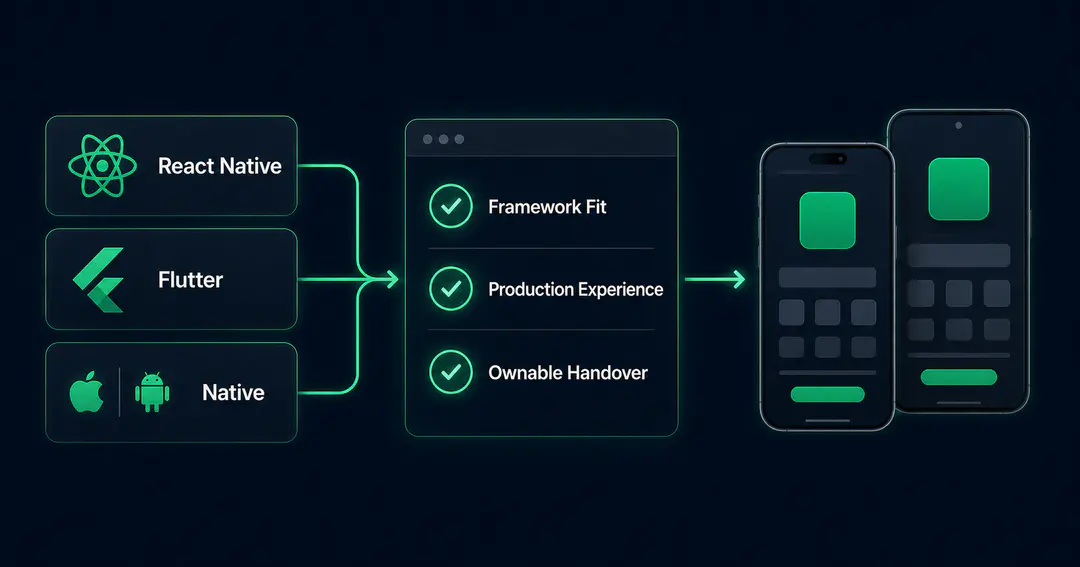
Summary: Hiring a mobile app team starts with a framework decision: React Native, Flutter, or native. A strong team can justify the pick for your product instead of defaulting to what it already knows. Beyond that, the thing that separates a strong team from a risky one is whether they have shipped real production apps, not just tutorials: native module integration, the React Native new architecture, offline and push edge cases, and the app store release and maintenance grind that never stops. And, as with any engagement, whether your team can own the app after they hand it over. Grade the production scars, not the portfolio screenshots.
A polished set of app store screenshots tells you a team can make something that looks good in a demo. It tells you almost nothing about whether they can ship and maintain a real mobile app, which is a genuinely harder thing than a lot of buyers expect. Mobile has a set of gotchas that a portfolio hides: app store review cycles, OS fragmentation, native module integration, offline states, and push notification edge cases, all of which show up only when real users on real devices start using the thing. The teams worth hiring have scars from all of them. The teams to avoid have screenshots. This guide is about telling them apart.
React Native, Flutter, or Native: Getting the Framework Choice Right
The first decision shapes everything after it, and a good team helps you make it rather than making it for you by default.
- React Native, backed by Meta, is almost always the right call when your product already lives in a JavaScript and React ecosystem, because you share business logic and hire from one talent pool. Instagram, Shopify, Microsoft Teams, and Amazon Shopping all ship it in production.
- Flutter, backed by Google, gives you tight control over a consistent UI across platforms and performs beautifully, at the cost of a separate language and ecosystem. Google Pay, Nubank, BMW, and Dream11 are built on it.
- Fully native, with separate iOS and Android codebases, is the right answer when you need the absolute best platform-specific performance and are willing to pay for two teams.
The two frameworks are genuinely different bets rather than interchangeable options, which is the argument we lay out in Flutter versus React Native. What you want from a candidate team is a recommendation grounded in your product, your existing stack, and your hiring plans, not in the framework they happen to prefer. A team that reaches for its favorite regardless of your context is putting its own comfort first, and you will feel that mismatch for years.
Shipped Real Apps, or Just Tutorials? The Gap That Matters
This is the gap that decides most mobile engagements. Cross-platform frameworks make it easy to build a demo and deceptively hard to build a production app, and the distance between the two is where inexperienced teams get exposed. The clearest example right now is the React Native new architecture, which became the default in React Native 0.76 in October 2024 and significantly changed how the framework bridges to native code. A team that has actually migrated real apps to it talks about it very differently from one that has read about it. Our write-up on the React Native new architecture in production is the kind of hard-won detail that separates the two.
So probe for that production experience directly. Ask what native modules they have had to write or integrate, because almost every real app eventually needs to reach past the cross-platform layer into platform-specific code. That boundary is where real React Native development happens and where tutorials stop. Ask about the hardest bug they shipped and fixed. A team that has shipped real apps answers with specifics and a slightly weary smile. A team that has done tutorials answers with generalities.
Offline, Push, and the Edge Cases That Break Mobile Apps
Mobile apps live in a hostile environment that web apps mostly do not: flaky connectivity, backgrounding, interrupted sessions, and devices that kill your process without warning. Handling this well is not a nice-to-have, it is the difference between an app people trust and one they delete. Offline support in particular is deceptively deep, involving local storage, sync, and conflict resolution that a demo never has to think about, as our comparison of offline-first approaches in React Native lays out.
Push notifications are a similar story, easy to make work in the happy path and full of platform-specific edge cases that only surface at scale. When you evaluate a mobile team, ask how they handle a user who has been offline for a day, or a notification that arrives while the app is backgrounded. The specificity of the answer tells you whether they have lived in production or only visited.
Brownfield: Can They Work in Your Existing App?
Not every mobile engagement is greenfield. Often you have an existing app and you want to extend it, modernize part of it, or add cross-platform screens to a native codebase, and that is meaningfully harder than starting fresh. Integrating a framework into an existing native app, sharing navigation and state across the boundary, and doing it without destabilizing what already ships is a specialized skill, and the kind of incremental approach we describe in the brownfield Flutter migration guide is what competent teams bring.
If your situation is brownfield, say so early and hand the team a real piece of your existing app to reason about. Whether that means Flutter development alongside your existing native screens or React Native modules dropped into an app that already ships, the skill is the same: improve it without breaking it. A team that immediately proposes a full rewrite of a working app, before understanding why it is the way it is, is showing you how it will treat your codebase throughout the engagement.

App Store Reality: Release and Maintenance Never Stop
Shipping the app is the start, not the finish. Mobile has an ongoing operational grind that a project-shaped mindset underestimates: app store review cycles that can block a release at the worst time, OS updates every year that can break things, and the need to push fixes to users who may never update. A team that treats release and maintenance as first-class has a real answer for how it handles all of this, including over-the-air updates and build automation, the ground our Expo EAS build and submission guide covers.
This is also where the classic mobile horror story lives: the team that goes dark after delivery, leaving you with an app that worked in the demo and now cannot be updated. Ask what ongoing maintenance looks like and what happens at handover, because a mobile app is a living thing that needs tending long after launch, and you need to be the one who can tend it.
Red Flags When You Hire a Mobile App Team
The warning signs cluster in a few places. The clearest is a portfolio of good-looking screenshots with no story about production: no native modules, no hard bugs, no app store battles. Another is a framework recommended without reference to your product, which usually means it is the only one they know. Watch for a team that treats offline, push, and OS fragmentation as afterthoughts, because those are exactly the things that break mobile apps in the field.
And be wary of the setup-and-vanish pattern, the team that ships the demo and disappears before the app meets real users and real maintenance. In mobile more than most places, the work after launch is the work, and a team that has not planned for it is a team that has not shipped much.
Hiring a Mobile App Team: The Short Version
Hiring a mobile app team comes down to four things worth settling before you sign:
- The framework. Make sure the team can justify React Native, Flutter, or native for your product rather than its own habit.
- The production scars. Native modules, the React Native new architecture, offline and push edge cases, and the app store release and maintenance grind.
- Brownfield fit. Ask them to reason about your real codebase, not a fresh one.
- Ownership. Insist, as with any engagement, that your team can own the app after handover.
Because much of this shares a talent pool and a mindset with the web, it is worth reading alongside what to look for when hiring a React development team if your search spans both.
This is how we run mobile engagements at Procedure, with the messy production reality treated as the actual job. See how we work on mobile development, or follow our engineering work on LinkedIn.
Frequently Asked Questions
Should I choose React Native or Flutter for my app?
It depends on your product and your existing stack, and a good team can justify the pick. React Native is usually the right call when your product already lives in a JavaScript and React ecosystem, because you share business logic and hire from one talent pool. Flutter gives tight control over a consistent UI across platforms and strong performance, at the cost of a separate language and ecosystem. Fully native suits apps that need the best possible platform-specific performance and can fund two codebases. A team that recommends one without reference to your context is a flag.
How do I know if a mobile team can actually ship production apps?
Probe for production scars, not screenshots. Ask what native modules they have written or integrated, how they handle offline and background states, how they deal with app store review cycles and OTA updates, and the hardest bug they shipped and fixed. Teams that have shipped real apps answer with specifics; teams that have done tutorials answer with generalities.
Can an outsourced team work on my existing mobile app?
Yes, but brownfield work is harder than greenfield and demands a specific skill: integrating into an existing codebase, sharing navigation and state across the boundary, and improving it incrementally without destabilizing what ships. Hand the team a real piece of your app to reason about. A team that proposes a full rewrite before understanding the existing app is showing you how it will treat your codebase.
What are the red flags when hiring a mobile app team?
A portfolio of screenshots with no production story, a framework recommended without reference to your product, treating offline and push and OS fragmentation as afterthoughts, and the setup-and-vanish pattern where the team disappears after delivery. In mobile, the work after launch is the work, so a team with no maintenance plan has usually not shipped much.
Procedure Team
Engineering Team
Expert engineers building production AI systems.