
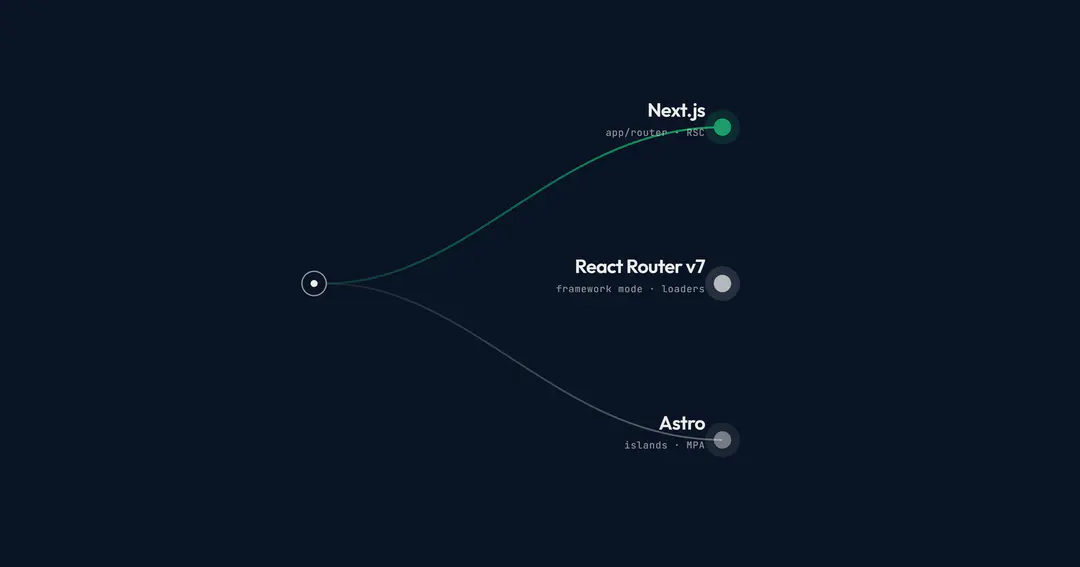
The JavaScript framework conversation in 2026 is not about which tool is "best." It is about which architecture matches what you are building. Next.js is the default for full-stack React applications with complex data requirements. React Router v7 is the successor to Remix, built on web standards with loaders, actions, and the freedom to deploy anywhere. Astro ships zero JavaScript by default and wins for content-first sites where performance is a hard requirement. Choosing the wrong one costs you months in workarounds, not days.
Whether you are comparing Astro vs Next.js, evaluating Remix vs React Router, or looking for the best React framework for a new project, the answer depends on what you are building. This guide breaks down where each framework genuinely wins, where it creates friction, and how to map your project's requirements to the right choice.
How to Choose Between Next.js, React Router v7, and Astro
Choosing between Next.js, React Router v7, and Astro comes down to three questions:
- How much of your application is interactive versus content?
- How important is vendor independence to your team?
- Do you need full-stack capabilities or a frontend-only solution?
Next.js is the strongest choice when you need React Server Components, streaming, and tight integration between data fetching and UI rendering. React Router v7 is the right pick when you want Remix-style loaders and actions without the branding confusion, and when deploying to non-Vercel infrastructure matters. Astro wins when your primary output is HTML: blogs, documentation, marketing sites, and content platforms where every millisecond of load time affects business metrics.
This guide covers each framework in depth, including where it genuinely wins, where it creates friction, and how to match your project's requirements to the right choice.
What Actually Changed: Remix Is Now React Router v7
Before comparing the three frameworks, it is worth addressing the biggest source of confusion in this space. Remix, as a standalone framework, no longer exists in the way most developers remember it.
In November 2024, the Remix team released React Router v7, which absorbed everything that made Remix distinctive: file-based routing, loaders, actions, and server-side rendering. If you are using React Router v7 with its "framework mode" enabled, you are effectively using Remix. The migration from Remix v2 to React Router v7 is a dependency update and a codemod that changes imports.
This matters for the comparison because searching for "Remix" in 2026 gives you outdated results. The Remix vs React Router distinction no longer exists in practice. The mental model, the data-loading patterns, the progressive enhancement philosophy: all of it now lives in React Router v7.
Separately, the original Remix team announced Remix 3 as a completely new project built on a fork of Preact, not React. It is experimental, not production-ready, and architecturally unrelated to what Remix v2 was. If someone on your team mentions "Remix," clarify which one they mean. For the purposes of this comparison, we are talking about React Router v7 in framework mode.
Next.js 16: The Full-Stack React Standard
Next.js is the most widely adopted React meta-framework, and version 16 solidifies its position as the default choice for complex, data-heavy applications.
Where Next.js Wins
React Server Components as a first-class feature. Next.js was the first major framework to ship production-ready RSC support. Components are server-rendered by default, and you opt into client-side interactivity with 'use client' only where you need it. This reduces the JavaScript shipped to the browser without requiring you to restructure your component tree.
Partial Prerendering (PPR). Next.js 16 graduates PPR closer to general availability. The concept: render a static shell from the CDN instantly, then stream in dynamic content. A product page can serve the layout, images, and description as static HTML in under 100ms while the user-specific pricing and inventory status streams in from the server. This is the first framework to blend SSG and SSR on a single page without requiring separate route configurations.
Turbopack for production builds. After years of being experimental, Turbopack is now stable in Next.js 16 for both development and production. Build times that took 45 seconds with Webpack now complete in under 10. For large codebases with hundreds of routes, this is a material improvement to developer experience.
The largest ecosystem. Next.js has the widest third-party integration support of any React framework: auth libraries (Clerk, NextAuth), CMS integrations (Sanity, Contentful, Strapi), analytics, monitoring, and deployment tooling. If you need a library for something, chances are it has a Next.js example in its docs.
Where Next.js Creates Friction
Next.js deploys to any Node.js server or Docker container, but features like Middleware, Edge Functions, and ISR work best on Vercel's platform. Teams looking for Vercel alternatives for Next.js will spend time configuring what Vercel handles automatically. You can leave. But the developer experience gap between Vercel and non-Vercel deployments is real, and it is the main reason React Router v7 and Astro appear in Next.js alternatives searches.
Next.js caching is the other pain point. Version 15 changed defaults so fetch requests are no longer cached automatically, a necessary correction. But the current model, understanding when to use revalidate, force-cache, no-store, and the new use cache directive, still trips up teams. Get it wrong and you end up with stale pages or unnecessary server load.
Bundle size matters for content sites. Even with Server Components, Next.js ships the React runtime for hydration, roughly 85 to 100KB gzipped. For a SaaS dashboard, that is fine. For a blog competing on Core Web Vitals, it is 85 to 100KB more than necessary.
The release cadence is fast. Pages Router to Next.js App Router was a significant migration. The caching model changed between 14 and 15. PPR and Next.js Turbopack have gone through multiple iterations. For teams that need stability over novelty, the pace of change adds maintenance overhead.
React Router v7: Web Standards Without the Abstraction
React Router v7 strips away everything except what the web platform already provides, then builds routing and data loading on top of standard Request and Response objects. For teams evaluating Next.js alternatives or the best React framework outside the Vercel ecosystem, this is the strongest contender.
Where React Router v7 Wins
- Progressive enhancement by default. Forms work without JavaScript. The server handles submissions via standard HTTP, and JavaScript adds pending states and optimistic UI when available. Your application's core functionality never breaks due to a JavaScript error. For e-commerce checkout flows, form-heavy workflows, and users on unreliable networks, this matters.
- The simplest mental model. Every route has a loader (data in), an action (mutations), and a component (UI). No server/client component distinction, no caching directives, no separate API route convention. If you have built REST APIs, this pattern is immediately familiar.
- Deploy anywhere. React Router v7 runs on Node.js, Cloudflare Workers, Deno, and any platform that supports standard web APIs. No preferred hosting provider, no features gated to one platform. Teams with existing infrastructure on AWS, GCP, or their own data centers can adopt it without changing their deployment story.
- Shopify's production validation. Shopify's entire frontend, including Hydrogen (their headless commerce framework), runs on React Router. When a framework powers one of the highest-traffic e-commerce platforms on the internet, the production-readiness question answers itself.
Where React Router v7 Creates Friction
The ecosystem is smaller than Next.js. No built-in image or font handling, no analytics integration out of the box. React Router gives you the primitives and expects you to bring your own solutions. For a senior team that prefers control, this is a feature. For a smaller team that wants batteries included, it is overhead.
Brand confusion from the Remix-to-React-Router merge still lingers. Searching for tutorials surfaces outdated Remix v2 content. Documentation has improved, but the learning path is less clear than Next.js's polished docs.
React Server Components in React Router v7 are still in preview. If RSC is central to your architecture today, Next.js is the safer bet. React Router's RSC story will mature, but it is not production-ready yet.
Automatic code splitting by route, responsive image components, and font handling all require manual setup. These are solvable problems, but they need deliberate effort that Next.js handles for you.
Astro: Zero JavaScript by Default
Astro takes a fundamentally different approach: assume JavaScript is unnecessary until proven otherwise. A fully static Astro page sends 0KB of JavaScript to the browser. When interactivity is needed, Astro's Islands architecture hydrates only the specific components that require it, not the entire page.
The Astro vs React comparison is misleading because Astro is not a React replacement. Astro uses React (or Vue, Svelte, Solid) as a component layer inside its own rendering model. You write React components, but Astro controls when and whether they ship JavaScript to the client.
Astro and Cloudflare: The Acquisition Changes Things
In January 2026, Cloudflare acquired Astro. The framework remains MIT-licensed and open-source, but it now has enterprise backing, a dedicated team at Cloudflare, and deeper integration with Cloudflare's edge network. Astro 6 beta introduced Vite Environment API and Workerd dev server integration. This is not a niche static site generator anymore. It is a content-first framework with serious infrastructure behind it.
Where Astro Wins
The best performance numbers for content sites. Astro's Largest Contentful Paint metrics are consistently 40 to 70% better than Next.js for content-heavy pages. When your site's primary job is to deliver text, images, and structured content, shipping zero JavaScript is the fastest path to perfect Core Web Vitals. IKEA, NordVPN, Porsche, and Cloudflare's own developer documentation run on Astro.
Framework-agnostic components. Astro is the only meta-framework that lets you use React, Vue, Svelte, Solid, and vanilla JavaScript components in the same project. If your team has developers with different framework backgrounds, or if you are migrating from one framework to another, Astro does not force a choice.
Content Collections and Content Layer API. Astro's content system provides a unified, type-safe interface for local MDX files, remote CMS content (Contentful, Sanity), and APIs. For documentation sites, blogs, and content platforms, this is the most ergonomic content management experience in any framework.
Cost efficiency. Static sites deploy to CDNs for minimal cost. No server runtime, no cold starts, no scaling concerns for the content layer. For marketing sites and documentation that receive millions of page views, the hosting cost difference between Astro and a server-rendered framework is significant.
Where Astro Creates Friction
Astro is not designed for full-stack SPAs. If every page needs authentication, real-time updates, and complex client-side state, the Islands model adds friction. Adding client:load to most components defeats the zero-JavaScript premise. Collaborative editors, real-time dashboards, and applications where most interactions happen on the client belong in a React framework.
Astro also uses full-page navigations by default, with View Transitions for smooth visual handoffs. Applications that need truly client-side navigation with preserved state between routes (a chat sidebar that stays open while the main content changes, for example) will fight Astro's model rather than work with it.
The community is smaller than Next.js. Fewer tutorials, fewer Stack Overflow answers, fewer battle-tested patterns for edge cases. The Cloudflare acquisition will grow the community faster, but as of mid-2026, Next.js's community remains significantly larger.
The Decision Framework: Match Architecture to Requirements
Whether you are comparing Astro vs Next.js for a content site, or React Router v7 vs Next.js for a full-stack app, skip the benchmarks and start with what you are building.
| You Are Building | Best Fit | Why |
|---|---|---|
| SaaS dashboard, admin panel, or complex web app | Next.js | Server Components reduce bundle size for authenticated apps. Deepest ecosystem for auth, payments, and third-party integrations. |
| E-commerce storefront with form-heavy checkout | React Router v7 | Progressive enhancement means checkout works without JavaScript. Shopify uses this pattern at scale. |
| Marketing site, blog, or documentation | Astro | Zero JavaScript by default means perfect Core Web Vitals. Content Collections make structured content easy. |
| Full-stack app on non-Vercel infrastructure | React Router v7 | No vendor coupling. Standard web APIs. Deploys to Node.js, Cloudflare Workers, Deno, or bare metal. |
| Content site with small interactive islands | Astro | Astro Islands hydrate only what needs interactivity. Best LCP scores. |
| Team scaling from 3 to 15+ React developers | Next.js | Largest talent pool. Most developers with Next.js experience. Lowest onboarding friction. |
| Edge-first application with global distribution | React Router v7 or Astro | Both deploy well to edge. React Router v7 for dynamic apps, Astro for content. |
Many production teams use more than one framework. Astro for the marketing site and documentation, Next.js or React Router for the application dashboard. Same domain, different subpaths, different tools suited for different jobs. This is a legitimate architecture when your content site and your application have fundamentally different requirements.
Server Components, Islands, and Progressive Enhancement: Three Models Compared

The architectural differences between these frameworks run deeper than API design. Each uses a different rendering model that shapes what you can build and how.
Next.js: React Server Components. Components run on the server by default. The server sends rendered HTML plus a serialized component tree to the client. Client components hydrate and become interactive. The benefit is a smaller client bundle and colocation of data fetching with UI. The cost is a new mental model (server vs. client components) and constraints on what you can do in each context.
React Router v7: Progressive Enhancement. Pages are server-rendered as full HTML documents. JavaScript loads and progressively enhances the experience: forms get pending states, navigation gets instant transitions, mutations get optimistic updates. If JavaScript fails to load, the page still works. The benefit is resilience and simplicity. The cost is that you do not get the same level of client-side interactivity control that RSC provides.
Astro: Islands Architecture. The page is static HTML. Individual components ("islands") are marked for hydration with directives like client:load or client:visible. Each island hydrates independently. The benefit is surgical precision over what JavaScript loads. The cost is that cross-island state management is more complex than in a unified React tree.
For most projects, one of these models is a natural fit. Data-heavy applications with complex state belong in React Server Components. Form-driven applications that need to work everywhere belong in progressive enhancement. Content-driven sites with occasional interactivity belong in Islands. The mistake is choosing a model that fights your project's primary use case.
Performance: What the Numbers Actually Show
Performance comparisons are often misleading because they compare "hello world" pages instead of real applications. Here is what matters in production.
| Metric | Astro | Next.js | React Router v7 |
|---|---|---|---|
| First Load (content page) | 0KB JS. Lighthouse scores 95-100. | 85-100KB gzipped (React runtime). Scores 80-95. | Similar to Next.js, slightly smaller framework footprint. |
| Time to Interactive (complex app) | Not the right tool for this use case. | Comparable to React Router v7. Both ship React runtime. | Comparable to Next.js. Gap narrows as app code dominates. |
| Subsequent navigations | Full-page with View Transitions. Visually smooth, no preserved state. | Prefetch and preload. Client-side navigations feel instant. | Same prefetch pattern via <Link>. Client-side navigation. |
The performance conversation matters most at the extremes. If you are building a content site and every Core Web Vital point affects SEO rankings, Astro's zero-JS approach is a measurable advantage. If you are building a SaaS application behind a login, the difference between Next.js and React Router v7 in terms of framework JavaScript is negligible, and your own code will dominate the bundle regardless.
When to Use Multiple Frameworks in One Project
The cleanest architectural decision is often using different frameworks for different parts of the same product.
Marketing site + Application. Astro for yoursite.com (blog, landing pages, documentation) and Next.js or React Router for app.yoursite.com (dashboard, user-facing features). The marketing site gets perfect performance scores without any compromise to the application's feature set.
Documentation + API Dashboard. Astro with Starlight for documentation (it is one of the best documentation frameworks available) and React Router v7 for the developer dashboard. Separate deployments, shared design tokens, unified brand.
The tradeoff: two build systems, two deployment pipelines, and potentially two sets of component libraries. For teams with fewer than five frontend developers, this complexity may not be worth the performance gain. For larger teams or products where marketing performance directly affects revenue, it is a reasonable architecture.
Picking the Right Framework for Your Team
Framework capability is only half the decision. The other half is your team's ability to ship and maintain it. If you are building a frontend engineering practice, the framework choice ripples through hiring, onboarding, and long-term maintenance.
Hiring. Next.js has the largest developer talent pool. Job postings that mention Next.js attract significantly more candidates than React Router v7 or Astro. If you are scaling a frontend team from 3 to 15 developers, the framework's popularity affects your hiring funnel.
Onboarding. React Router v7's mental model (loaders, actions, components) is the simplest to learn. Next.js's Server Component model has a steeper learning curve, especially the server/client boundary rules and caching behavior. Astro is approachable for developers coming from any framework background because it does not require deep React knowledge.
Long-term maintenance. Next.js releases frequently, and major versions sometimes require migration effort (Pages Router to App Router was significant). React Router v7 has a track record of smooth major version upgrades. Astro's upgrade path has been straightforward, though the Cloudflare acquisition may accelerate its release cadence.
The framework your team can ship quickly and maintain for two years matters more than any benchmark.
Choosing the Right Frontend Framework in 2026
The frontend framework space in 2026 is not confusing because the options are bad. It is specialized. Next.js, React Router v7, and Astro are each excellent at different things, and choosing the right one is an architecture decision, not a popularity contest.
Procedure's engineering team builds production frontends in React and Next.js across SaaS, fintech, and media products. Follow our work on LinkedIn.
If you are evaluating your framework choice for a new project or weighing a migration, talk to our frontend team about the tradeoffs with specifics from your stack.
Frequently Asked Questions
Should I choose Next.js, React Router v7, or Astro for my next project?
Next.js for full-stack React apps with complex data needs. React Router v7 for form-heavy apps and vendor independence. Astro for content sites where performance is the top priority.
Is Remix dead? What happened to it?
Everything that made Remix v2 great (loaders, actions, progressive enhancement) now lives in React Router v7. The migration from Remix v2 is a dependency update and import codemod. Remix 3 is a separate, experimental project built on Preact, architecturally unrelated to Remix v2.
Can I use multiple frameworks in one project?
Yes, and many teams do. A common pattern is Astro for the marketing site and documentation, with Next.js or React Router for the application. Different subpaths, different frameworks, each built for its specific job.
Is Next.js locked to Vercel?
No. Next.js runs on any Node.js server, Docker, or serverless platform. However, some features (Middleware, Edge Functions, ISR) work best on Vercel. The developer experience gap between Vercel and self-hosted deployments is real but manageable.
Is Astro only for static sites?
No. Astro supports server-side rendering via adapters for Node.js, Cloudflare, Deno, and Vercel. It handles dynamic content, API routes, and authenticated pages. However, its architecture is built for content-first sites, and full-stack SPAs are not its strongest use case.
Can Astro use React components?
Yes. Astro is framework-agnostic. You can use React, Vue, Svelte, Solid, or vanilla JavaScript components in the same Astro project. Astro controls whether those components ship JavaScript to the client using its Islands architecture and hydration directives like client:load and client:visible.
Which framework has the best performance?
For content sites, Astro delivers the best performance by shipping zero JavaScript. For interactive applications, Next.js and React Router v7 perform comparably, with React Router v7 having a slightly smaller framework footprint. Real-world performance depends more on your architecture decisions than on framework choice.
How does TanStack Router compare to React Router v7?
TanStack Router focuses on type-safe, client-side routing with deep TypeScript integration. React Router v7 is a full framework with server-side rendering, loaders, actions, and progressive enhancement. If you need SSR and form handling, React Router v7 is the more complete solution. If you are building a client-side SPA and want the strongest TypeScript DX, TanStack Router is worth evaluating.
Should I migrate from Next.js Pages Router to App Router or switch frameworks entirely?
If the Pages Router meets your needs, the upgrade to App Router is worthwhile for React Server Components and streaming. Switching frameworks entirely only makes sense if your project's requirements have fundamentally changed, like shifting from an application to a content-heavy marketing site.
Procedure Team
Engineering Team
Expert engineers building production AI systems.