
You are three months into a project. The API is live, things are mostly working, and then one of your senior engineers casually mentions, "We probably should have gone with Python for this."
Nobody argues back too hard. But nobody wants to rewrite it either.
This happens more than teams admit, and it almost always traces back to the same root cause: the decision was made without a framework. Someone defaulted to what the last company used, or picked whatever topped a benchmark post from 2021. What you actually need is a way to think through this before you are three months in.
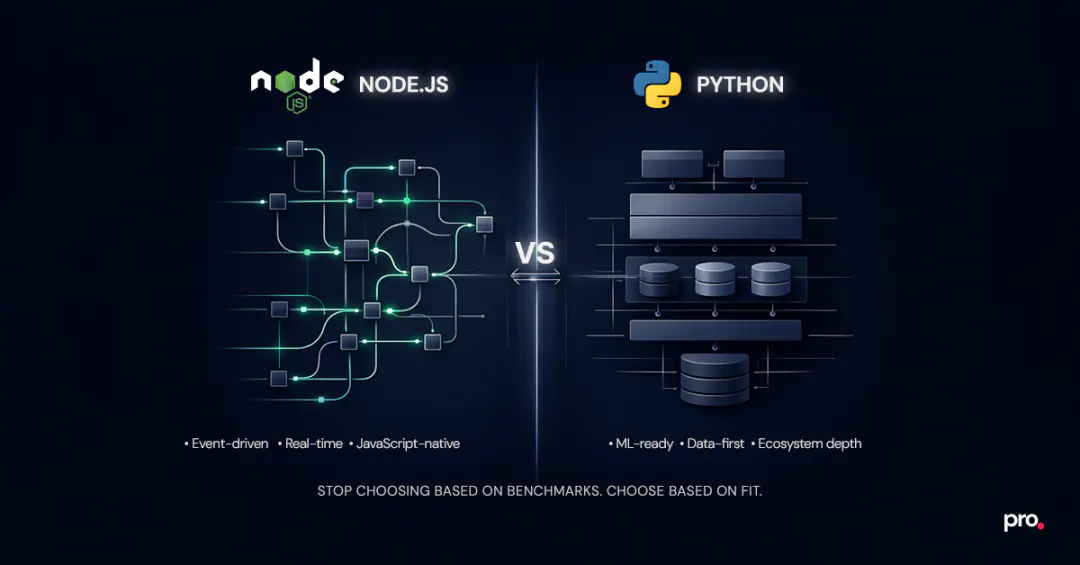
Node.js works best for real-time, high-concurrency backends, especially in JavaScript-first teams. Python is the stronger pick when your backend touches data processing, machine learning, or complex business logic. For most standard REST APIs, neither has a meaningful performance edge over the other. The bigger variable is whether your team is confident in what they are running.
For what it's worth: Netflix, LinkedIn, and Uber run significant parts of their backend on Node.js. Dropbox, Instagram, and Spotify rely heavily on Python. Both stacks have proven themselves at serious scale. The technology is not the constraint.
That is the summary. Here is how each of those claims actually holds up.
Node.js vs Python: The Architecture Difference That Actually Matters
Understanding the Node.js vs Python architecture difference means knowing how each model behaves under real load, not just in theory.
Node.js runs on an event loop powered by libuv, a C library that handles async I/O across platforms. A single thread processes all incoming requests without blocking. While waiting on a database or external API, it moves on to the next. This keeps Node lean under high concurrency without spinning up a thread per connection. For CPU-bound work, Node does have worker threads, but they are an opt-in escape hatch, not a default model. If your backend regularly does heavy computation, you are working around Node's design, not with it.
Python in its default CPython form has the Global Interpreter Lock (GIL). Only one thread executes Python code at a time. For CPU-bound work, Python's answer is multiprocessing: spawning separate processes that bypass the GIL entirely. For I/O-bound tasks, the GIL is released during I/O, which is why frameworks like FastAPI perform well despite it.
FastAPI has genuinely shifted the Python performance conversation. It is async-first, built on Starlette and Pydantic, and benchmarks competitively with Express.js for typical I/O-bound API workloads. For a REST API under 10,000 concurrent users, both stacks handle the load fine. Performance alone will not make or break your product.
That narrows the decision down to fit: which stack is actually designed for what you are building.
| Node.js | Python (CPython) | |
|---|---|---|
| Concurrency model | Single-threaded event loop (libuv) | GIL — one thread at a time |
| I/O-bound workloads | Excellent — non-blocking by default | Good — GIL released during I/O |
| CPU-bound workloads | Worker threads (opt-in) | Multiprocessing (bypasses GIL) |
| Async framework | Native (async/await, EventEmitter) | FastAPI / asyncio |
| ML/AI libraries | Limited (ONNX, TF.js — partial) | Full ecosystem (PyTorch, TensorFlow, LangChain) |
| Typical use case | Real-time APIs, WebSockets, BFF layers | Data pipelines, ML inference, analytics |
4 Scenarios Where Node.js Is the Right Backend Choice
The strongest case for Node.js as a backend is not raw speed. It is architectural fit for the kind of system you are actually building.
- Real-time features: WebSockets, live dashboards, collaborative editing, push notifications. Node's event loop handles persistent connections the way it was designed to. Python can do real-time with Django Channels, but you are working against the grain of the language under load.
- JavaScript-first teams: If your frontend is React or Next.js and your team already thinks in JavaScript, a Python backend adds context-switching overhead: two mental models, two debugging patterns, two onboarding paths. Keeping the stack unified lets your team move freely across the codebase.
- Lightweight microservices: API gateway logic, authentication, BFF layers. No heavy computation. Node services stay lean and deploy fast.
- Deadline pressure with a team that knows the stack: Familiarity compounds. Do not switch to a theoretically better stack when your team has solid working patterns in what they know.
If you are evaluating Node.js for a production backend, the strongest signal is a real-time requirement combined with a JavaScript-fluent team. If neither of those apply, Python is likely the smarter pick.
3 Cases Where Python Has No Real Competition
There are categories where Python does not just hold its own against Node.js. It is so far ahead that no amount of Node ecosystem patching closes the gap.
If your backend touches ML or AI at all, start in Python. TensorFlow, PyTorch, and the entire LLM tooling ecosystem (LangChain, LlamaIndex, most vector database SDKs) are Python-first. In a Node.js backend, the moment you add ML you end up calling a Python service anyway — you have just built two stacks and gotten the worse version of the split. If your roadmap has anything AI-adjacent in the next 18 months, start in Python now. Retrofitting later is expensive and the architectural seams do not disappear cleanly. For a deeper breakdown of which Python framework to use once you have made this call, see our comparison of FastAPI vs Django vs Flask.
Data-heavy backends: ETL pipelines, analytics, batch processing, reporting. Python's ecosystem (Pandas, Celery, SQLAlchemy) is purpose-built here.
Teams with Django or FastAPI depth: Django's batteries-included approach speeds up early development when your backend has complex data models. FastAPI with async now handles I/O-bound workloads competitively with Express.js. The performance gap from five years ago has mostly closed.
Of course, choosing one does not always mean excluding the other.
Running Node.js and Python Together: More Common Than You Think
Using Node.js and Python together in the same system is not an evasive answer. It is how a lot of production systems at scale are actually architected.
The pattern:
- Node.js handles the API layer: authentication, routing, real-time features via WebSockets or SSE
- Python handles the computation: ML inference, data processing, batch analytics, as separate services over internal REST APIs or a message broker like Kafka
┌───────────────────────────────────────────────────────┐
│                    Client / Frontend                    │
└────────────────────────┬──────────────────────────────┘
                         │ HTTPS
┌────────────────────────▼──────────────────────────────┐
│               Node.js — API Layer                       │
│  Auth · Routing · WebSockets · Real-time features       │
└──────────────┬────────────────────────┬───────────────┘
               │ Internal REST / Kafka   │ Internal REST
┌──────────────▼────────────┐   ┌───────▼───────────────────────┐
│  Python Service 1          │   │  Python Service 2              │
│  ML Inference              │   │  Data Pipeline / Analytics     │
│  (PyTorch / ONNX)          │   │  (Pandas / Celery)             │
└───────────────────────────┘   └───────────────────────────────┘
Where this makes sense in practice:
- A fintech platform: Node.js for the transaction API, Python for the fraud detection model running asynchronously
- A SaaS product that added ML features after launch: the web layer stays Node, the ML modules are Python services
- Any product where the API and data processing pull in genuinely different technical directions
The tradeoff is real: two languages, two build pipelines, and two separate bodies of knowledge your team needs to maintain. Worth it when requirements genuinely diverge, not as a hedge against making a decision.
Why Team Fit Matters More Than Framework Benchmarks
Picking a backend stack based on benchmarks is like hiring based on a typing speed test. It measures something real, but not the thing that actually determines outcome.
Familiarity beats benchmarks. A Python team that knows FastAPI well will ship faster and debug more effectively in Python than in Node.js. The velocity difference between a confident team and one learning a new stack is larger than the performance difference between these technologies for most workloads.
The hiring market is healthy on both sides. In India, JavaScript developers are plentiful given the frontend ecosystem. Python has grown sharply with the AI boom and topped the Stack Overflow 2024 Developer Survey as the most-wanted language for the third year running. You are not at a disadvantage either way.
Python's readability is a real onboarding advantage. A new engineer joining a Django codebase typically gets up to speed faster than one stepping into a custom Express stack with layered middleware they did not write.
If you work with an external engineering partner, pick the stack they have proven depth in. A team that has shipped five Node.js production systems will give you meaningfully better results than one trying it for the first time.
Beyond team dynamics, there are operational tradeoffs that only surface once you are running this in production. Node async debugging can be opaque: stack traces in async contexts are harder to follow than Python's synchronous ones, and distributed tracing adds complexity quickly. Python worker processes have a higher memory footprint per process than Node's single-threaded model, which matters at scale.
For serverless deployments, Node typically cold-starts faster, while Python with heavier ML dependencies can be slow to warm. For long-running CPU-bound workflows, Python's worker ecosystem (Celery, multiprocessing, Dramatiq) is more mature and better documented than Node's explicit worker thread model. None of these are dealbreakers, but they should be on your radar before you commit.
Node.js vs Python: Decision Guide by Use Case
If you have read this far, you have enough context to use this Node.js vs Python decision table without oversimplifying.
| Your situation | Recommended stack |
|---|---|
| Real-time: WebSockets, live updates, notifications | Node.js |
| AI or ML integration, now or within 18 months | Python |
| Full-stack JavaScript team in place | Node.js |
| Data processing, analytics, ETL backend | Python |
| Standard REST API, Python team | Python + FastAPI |
| Standard REST API, JavaScript team | Node.js + Express or NestJS |
| Lightweight microservices, I/O-heavy, no ML | Node.js |
| Startup MVP, complex domain logic | Python + Django |
| Product needs both real-time and ML | Use both, split at the service boundary |
| No team bias + uncertain roadmap | Python (more forgiving long-term) |
The clearest signal: if ML or AI is anywhere on your roadmap in the next 18 months, start in Python. Switching later is expensive and the seams do not go away cleanly.
Making the Right Call Before You're Three Months In
Back to that team three months in. Were they wrong to go with Node.js? Almost certainly not. If they were a JavaScript team building a standard API without real-time or ML requirements, the decision was defensible. The problem was it was not made deliberately. It was made by default.
Team skills first. Product requirements second. Hiring market third. Benchmarks last.
The best backend stack is not the fastest one. It is the one your team can operate confidently at scale.
We've built and scaled backends in both Node.js and Python across products in fintech, healthtech, and enterprise SaaS. If your team is weighing this decision for a real project, take a look at our Node.js development and Python development work, or talk to our senior engineers (not sales) directly and we'll share what we've seen work.
Procedure Team
Engineering Team
Expert engineers building production AI systems.