
Summary: Python is fast to write and does not enforce types or structure for you. It spans web, data, and AI, and it has three major backend frameworks. That makes it easy to get an external team started, and just as easy for the engagement to go wrong. When outsourcing Python development, grade three things a demo will not show: whether they chose Python and its framework (Django, FastAPI, or Flask) for your workload rather than their own habit; whether they bring discipline to a dynamically typed language through type hints, tests, and structure; and whether your team can own the codebase after they leave. Grade the judgment, not the speed.
Python is one of the easiest languages to start a backend in, which is both why teams reach for it and why an external engagement can go sideways. It is readable, it is fast to write, and it is forgiving of loose structure. That forgiveness is a gift when a disciplined team uses it and a liability when a team moves fast and leaves you with an untyped, untested codebase nobody outside the original authors can safely change. If you are still deciding whether Python is the right runtime at all, our Node.js versus Python comparison is the better first read. This piece assumes Python is the call and you are choosing who builds it.
The thing that makes Python engagements distinct is that the language spans three worlds. The same ecosystem powers web backends, data pipelines, and AI and machine learning systems. That breadth is why Python is so often the right answer, and also why the evaluation is more than "can they write Python." It is whether they chose it, and the tools around it, for your problem rather than for their comfort.
Is Python the Right Call, and for the Right Reasons?
Start by pressure-testing the choice itself. Python earns its place on data-heavy and AI-adjacent backends, on teams that already have deep Python and Django or FastAPI experience, and on systems where developer speed and readability matter more than raw per-core throughput. Those are good reasons. "It is what we always use" is not, and neither is a benchmark from a blog post.
A team worth hiring can articulate why Python fits your workload specifically, and will tell you when it does not. If your system is a high-throughput, CPU-bound service with tight latency budgets, a candidate that reflexively reaches for Python without acknowledging the tradeoffs is putting its own familiarity first. The honesty to say "another runtime suits this better" is a buying signal, and the absence of it is a quiet flag you will pay for later.
Django, FastAPI, or Flask: The Framework Choice You Should Understand
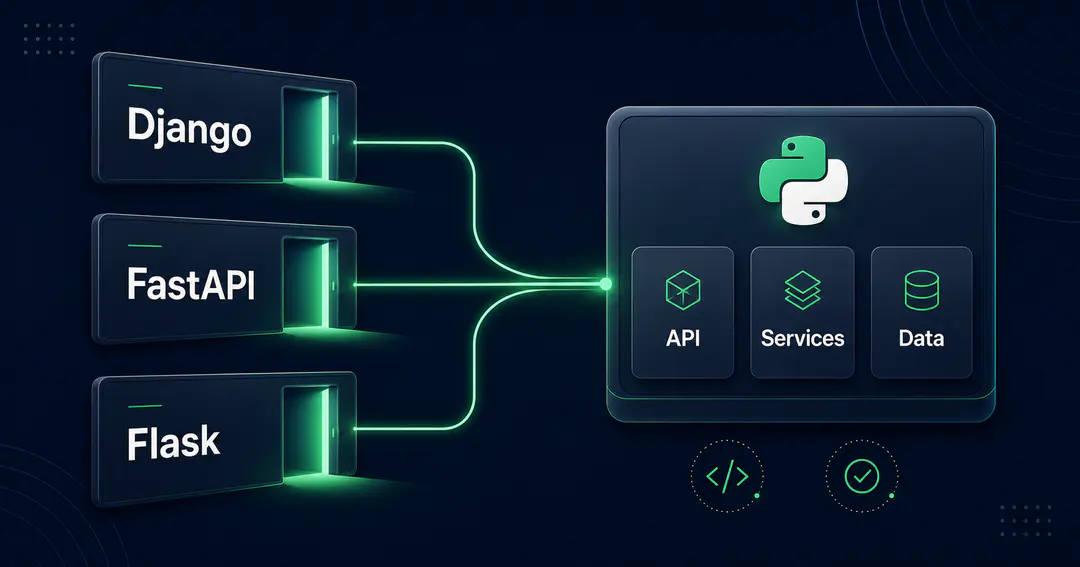
Python's backend story is really three stories, and the choice between them has long maintenance consequences.
- Django is batteries-included. It shines when your backend has rich data models and you want structure and an admin out of the box.
- FastAPI is the modern async choice for API-first services, and it handles I/O-bound workloads well.
- Flask is minimal and flexible, which is freeing for small services and a footgun for large ones, because everything the other two give you for free becomes something your team has to build and maintain.
You do not need to dictate the framework, but you should insist the team can justify its pick against your workload rather than defaulting to the one it knows. Our breakdown of FastAPI versus Django versus Flask is the decision framework to hand them, and a strong team will already reason this way. The wrong framework is not a catastrophe on day one. It becomes one over eighteen months, as your team fights the grain of a choice it never got to weigh in on.
Why Discipline Matters More on a Python Backend
Here is the Python-specific risk that decides most engagements. Python is dynamically typed and structurally permissive, so a team can move quickly and leave behind code that runs today and terrifies your engineers tomorrow. The discipline that keeps a Python codebase maintainable is not automatic, and it is exactly what to look for.
That discipline has concrete markers. Type hints, checked with a tool like mypy, so the codebase documents its own contracts and catches a class of bugs before runtime. Real test coverage, which matters more in a dynamic language precisely because the compiler is not catching mistakes for you. And a sensible, conventional structure rather than a clever bespoke one that only its author understands. A team that treats types and tests as optional extras is handing you speed now in exchange for a codebase your people cannot safely touch later. Ask to see real production code, not a demo, and look for these markers directly.
Concurrency and Scale: What a Python Team Should Know
Python's concurrency story is nuanced, and a team's fluency with it is a good proxy for real production experience. The historical constraint, the global interpreter lock, shapes how Python handles parallelism, and the right approach depends entirely on whether your workload is I/O-bound or CPU-bound. Asyncio handles high-concurrency I/O well; CPU-bound work needs a different strategy, and the recent moves toward free-threaded Python are changing the calculus again.
A team that can talk clearly about when to use async, when to reach for multiple processes, and how it would scale your specific workload has run Python where it matters. One that treats concurrency as an afterthought will discover the limits in production, on your traffic. Our write-up on Python concurrency after the GIL is the depth a serious team brings unprompted, and a fair thing to probe for in evaluation.
When Your Python Backend Touches Data and AI
Many Python backends are chosen precisely because they sit next to data pipelines or machine learning, and if yours does, the evaluation gets an extra dimension. A team building a plain CRUD API needs different depth from one wiring your backend into ETL, analytics, or an ML or LLM system. Be clear about which you are, and make sure the team you hire has actually shipped the flavor you need, because Python web experience does not automatically transfer to production data and AI work. If the work is genuinely AI rather than data-adjacent, the same evaluation lens applies, and our guide to hiring an AI engineering team covers what to probe for beyond the demo.
This is where Python's breadth is a genuine asset, provided the team has the right slice of it. The Python engineering work that pairs backends with data and ML is a different muscle from CRUD web development, and the strongest signal is a team that asks about your data and AI ambitions early rather than treating the backend as an isolated web service.
Red Flags When You Hire Python Developers
The trouble signs are consistent. The clearest is a codebase with no type hints and thin tests, dressed up as velocity, because that is debt you have not been billed for yet. Another is a framework chosen for the team's convenience with no justification against your workload, or a refusal to consider that Python might not be the best fit at all.
Watch for cleverness over clarity, since Python's expressiveness tempts talented engineers into intricate one-liners that only they understand. Boring, readable code is what your team can maintain. And be wary of resistance to your engineers reviewing pull requests, which almost always signals a team protecting its own indispensability rather than your outcomes.
How to Evaluate a Python Development Company Before You Commit

The evaluation is a conversation, and the right questions filter fast. Five worth asking every candidate:
- Why does Python fit our workload, and what would make you recommend against it?
- Which framework would you choose here, and why that one over the other two?
- Can we see real production code rather than a demo? Look for type hints, tests, and structure.
- How would you scale this specific workload as traffic grows?
- What does handover look like at the end?
That last question carries the same weight it does on any external engagement, and it is the same standard we described for a Node.js backend built with an external team. You are not buying a running service. You are buying a running service plus the ability to own it once the builders are gone, and with a forgiving language like Python the second half depends entirely on the discipline the team brought to the first.
Outsourcing Python Development: The Short Version
Python is easy to start and easy to make a mess of, so grade the judgment, not the speed. Look for a team that chose Python and its framework for your workload rather than their habit, that brings type hints, tests, and structure to a dynamic language, that understands the concurrency realities of your traffic, and that leaves your engineers able to own the codebase. A team that sometimes tells you Python or a given framework is the wrong fit is the one worth trusting with the ones where it is right.
That discipline, and a clean handover, is how we run Python engagements at Procedure. See how we work on backend development, or follow our engineering work on LinkedIn.
Frequently Asked Questions
Should I hire a Python development company or use staff augmentation?
This is really a question of who owns the architecture. A Python development company takes the outcome off your plate, deciding framework, structure, and testing itself, which fits teams that want a finished backend. Staff augmentation is the reverse: Python engineers work under your technical direction, which fits teams that already own the architecture and need senior capacity. Whichever you pick, write type discipline, test coverage, and handover into the deliverables, because Python's flexibility is what makes those the line between a maintainable codebase and an expensive one.
Django, FastAPI, or Flask: which should an outsourced team use?
It depends on your workload, and the right answer is that the team can justify its choice. Django suits backends with rich data models that benefit from a batteries-included framework and admin. FastAPI is the modern async choice for API-first, I/O-bound services. Flask is minimal and flexible, best for small services where you want control and are willing to build the rest yourself. A team that defaults to one without weighing it against your needs is a flag.
What are the red flags when outsourcing Python development?
A codebase with no type hints and thin tests presented as speed, a framework chosen for the team's convenience with no justification, cleverness over readable code, and resistance to your engineers reviewing the work. Python is forgiving enough that these do not show up in a demo, but they decide whether your team can maintain the result.
Is Python a good choice for an outsourced backend?
For data-heavy, AI-adjacent, and API-first backends, and for teams that value developer speed and readability, yes, and its large talent pool makes an external team easy to staff. The caveat is that Python is dynamically typed and permissive, so the discipline of the team matters more here than on a stricter language. Whether Python beats an alternative like Node.js for your specific workload is worth settling before you start.
Procedure Team
Engineering Team
Expert engineers building production AI systems.