
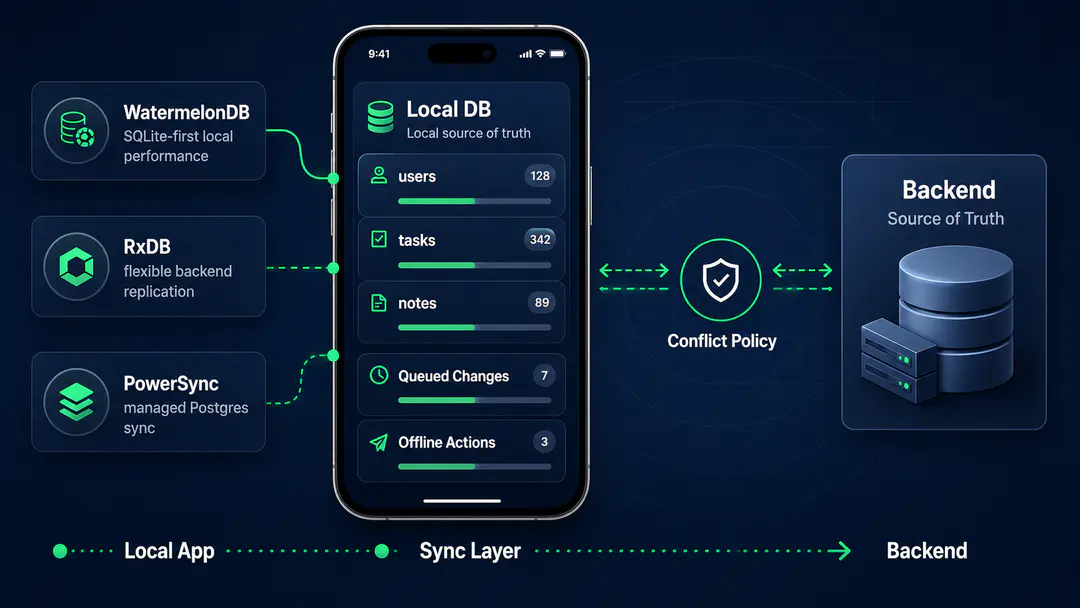
React Native offline-first means the app treats a local database as the primary runtime source, syncing with the server when connectivity allows. In 2026, the three serious choices for a react native offline first app are WatermelonDB (SQLite performance with custom sync), RxDB (backend flexibility with reactive queries), and PowerSync (managed Postgres sync with built-in conflict handling). Most production apps do not need CRDTs. Last-write-wins with server-side validation covers the majority of real conflicts.
That framing matters because offline-first is not a feature decision. It is a system design decision.
Most teams arrive here after requests fail intermittently, retries behave unpredictably, and user actions get lost in edge cases that are hard to reproduce. The instinctive response is to "add offline support," but that hides the actual problem: you are introducing a second source of truth on the device and a mechanism to reconcile it with the backend.
The React Native ecosystem now has mature options for this, each built around a different assumption about sync and consistency. The mistake is evaluating them as interchangeable libraries. The right approach is to define how your system behaves under conflict, then pick the tool that supports that model.
When Offline-First Is Worth the Investment
Offline-first introduces ongoing complexity, so it only makes sense in two situations.
The first is operational workflows where users must complete tasks regardless of connectivity: field apps, logistics systems, inspection tools, healthcare workflows. Network conditions are unpredictable, and blocking the user is not an option.
The second is B2B SaaS products that act as daily workflow tools and systems of record. Even short disruptions break user trust when the application is the source of truth.
Outside of these, offline-first is usually unnecessary. Consumer apps can tolerate transient failures. Early-stage products benefit more from simpler architectures. The question is not whether offline support is useful, but whether the system can handle the complexity it introduces over 18 months.
The Three Layers That Define Every Offline-First System
Every react native offline first implementation reduces to three decisions.
The local data store determines how data is represented and queried on the device. This is your react native local database layer, and it directly affects performance on large datasets.
The sync layer defines how changes move between the client and the backend. It controls when synchronization happens, how retries work, and what happens when updates fail midway.
The conflict resolution policy defines how the system behaves when two sources disagree. This is the only layer that directly impacts correctness.
Most teams focus on the first two because they are visible in APIs and documentation. The third gets treated as an implementation detail. In practice, it is the constraint that shapes the entire system.

WatermelonDB: When React Native SQLite Performance Is the Constraint
WatermelonDB is built around a simple assumption: the bottleneck in offline-first mobile apps is usually local database performance, not synchronization.
WatermelonDB React Native apps use SQLite directly, keeping operations lazy by design. Queries execute only when needed. Records load incrementally instead of materializing large object graphs into JavaScript memory. This matters once datasets exceed a few thousand records and the app renders continuously reactive views.
With React Native's New Architecture and JSI, react native sqlite operations no longer pay the same bridge serialization cost. WatermelonDB benefits disproportionately from this because its architecture depends on high-throughput native database access, especially on lower-tier Android devices where bridge overhead used to become visible under load.
Where WatermelonDB becomes demanding is synchronization. The library avoids prescribing a sync strategy. It exposes primitives for custom pull and push behavior, which gives teams full control but leaves sync ordering, retry semantics, conflict handling, and deletion strategies as their responsibility.
Schema evolution requires discipline too. WatermelonDB migrations are strict and structured. Teams without strong migration hygiene tend to feel this pain later rather than earlier.
WatermelonDB is usually the right choice when:
- Large local datasets are unavoidable and react native database performance is the primary constraint
- The team wants full control over synchronization logic
- Backend engineering capacity already exists internally
- Sync itself contains domain-specific business rules
It is less attractive when the goal is rapid implementation with minimal sync infrastructure ownership.
RxDB: When Backend Flexibility Matters More Than Raw SQLite Throughput
RxDB approaches the react native database problem from a different direction. Where WatermelonDB is a high-performance local database with configurable sync primitives, RxDB is a reactive data layer that can replicate against multiple backend systems with minimal friction.
This distinction matters because many teams adopting offline-first are not starting from a clean slate. The backend already exists. The APIs already exist.
RxDB React Native deployments typically use SQLite-backed storage, but the abstraction layer allows the same data model to work across mobile and web. For teams maintaining shared frontend architectures, the sync logic does not need to be rewritten per platform.
The replication model is broader than most offline-first libraries. RxDB supports GraphQL, CouchDB-style replication, REST-based sync, Firebase-compatible patterns, and Supabase integrations. WatermelonDB assumes the team will own sync directly. RxDB assumes sync is a reusable capability that should adapt to existing backends.
The tradeoff is overhead. Teams need to understand RxJS-driven reactive patterns, replication flows, and revision handling before the system becomes easy to work with. There is also a performance gap compared to SQLite-first systems on very large local datasets.
Schema management is where RxDB is clearly stronger. Migrations, versioning, and evolution workflows are more ergonomic than most SQLite-centric libraries, which reduces operational friction in long-lived apps.
Licensing is worth noting: a meaningful portion of RxDB's production functionality (replication, encryption, attachments) lives behind premium plugins. The architecture often grows around those plugins over time.
RxDB fits best when:
- The backend already exists with established APIs
- Multiple sync targets or shared web/mobile architecture matter
- Schema evolution and TypeScript ergonomics are priorities
- Reactive data models are preferred
PowerSync: When You Want React Native Sync as Managed Infrastructure
PowerSync takes a completely different approach. Instead of treating synchronization as something the application team builds, PowerSync React Native treats it as infrastructure that should already exist.
Your backend database remains the primary source of truth. PowerSync handles replication, local persistence, and sync between client and server automatically. The client still uses a local SQLite database under the hood, but the sync layer is abstracted behind the platform.
This model fits naturally into Postgres-centric architectures. PowerSync integrates well with Postgres-backed systems, including Supabase setups, because the sync model is based on database-level replication rather than custom API orchestration. Teams define sync rules that determine what subset of data exists on each client device, rather than building sync endpoints manually.
Conflict handling is more opinionated. Last-write-wins exists by default, with server-side validation and custom resolution logic where needed. This is usually sufficient for most business apps because real-world conflicts are sequencing problems, not collaborative editing problems.
The tradeoffs are dependency and cost. PowerSync is not just a library. It becomes part of the system architecture, so operational lifecycle, pricing, and platform constraints become engineering considerations. Pricing scales with data volume, active users, and replication frequency, which means react native sync becomes an operational cost center.
PowerSync fits best when:
- The backend revolves around Postgres
- The team wants sync offloaded as managed infrastructure
- Faster implementation matters more than low-level sync control
- The app is operationally complex but not collaboratively intensive
Other Options: Realm, Replicache, and ElectricSQL
The react native offline mode ecosystem is broader than the three tools above.
Realm remains technically capable, but since the transition toward Atlas Device Sync, teams need to evaluate ecosystem dependency and vendor alignment carefully. The challenge is platform direction, not capability.
Replicache solves a different problem entirely. It is built for collaborative software where multiple users continuously edit shared state, similar to Linear, Notion, or Figma. For most B2B applications, it is more system than necessary.
ElectricSQL offers a promising Postgres-to-SQLite replication model, but React Native support and operational maturity are still early compared to the established options. Worth watching, not yet the default choice for production.
The Conflict Resolution Decision Most Teams Get Wrong
Conflict resolution is the decision most teams postpone until synchronization is already working. In reality, it determines whether the system remains understandable once real-world usage creates inconsistent state.
Most teams also overestimate how sophisticated their conflict model needs to be. CRDTs and operational transforms solve genuinely difficult problems in collaborative software, but those systems exist for environments where multiple users edit the same data concurrently and every intermediate state matters.
Most applications do not work this way. A delivery status gets updated twice. A field inspection record is edited from two devices. A form submission collides with a remote modification. These are sequencing problems, not collaborative editing problems.
Last-write-wins combined with server-side validation is completely acceptable for these cases. The goal is not preserving every change. It is ensuring the system reaches a predictable, auditable final state.
Three patterns matter consistently in production offline-first mobile app systems:
- Soft deletes over hard deletes. Deletion propagation during sync is one of the easiest places to introduce irreversible inconsistencies.
- Server-side validation stays authoritative. Regardless of what the client believes the current state is.
- Audit history exists by default. Eventually a user will ask why their change disappeared after synchronization.
The most maintainable offline-first systems are the ones where the rules remain predictable months after launch, not the ones with the most sophisticated merge logic.
How React Native's New Architecture Changes Offline-First Performance
Under the old architecture, database-heavy apps paid a consistent cost moving data between native storage and the JavaScript runtime through the bridge. As local queries grew larger or more frequent, this serialization cost became increasingly visible, particularly on lower-end Android devices.
JSI changes that model. Native modules communicate more directly with the JavaScript runtime. For offline-first systems built around SQLite, this matters because application responsiveness depends on how fast local reads and writes execute under continuous sync pressure.
WatermelonDB gains the most from this shift because its design already assumes the local database is doing heavy runtime work. RxDB benefits more indirectly: storage adapters improve, but the abstraction layers above SQLite mean the gains are less dramatic. PowerSync sees the least direct impact because sync remains abstracted behind managed infrastructure.
The practical result: react native offline first apps that previously struggled once local datasets crossed a few thousand records are now far more viable under production workloads. This shift is one reason offline-first architecture in React Native feels materially more production-ready in 2026.
We covered these changes in more detail in our guide on React Native's New Architecture in production.
Decision Framework: Pick Based on Constraints, Not Popularity
All three systems can support serious offline-first React Native applications. The challenge is identifying which constraint dominates your system.
Teams that focus on the wrong constraint usually end up rebuilding sync behavior later, even if the initial implementation looked successful.
| Your Situation | Recommended Choice | Why |
|---|---|---|
| Large local datasets with performance-sensitive querying | WatermelonDB | SQLite-first architecture scales best under heavy local read pressure |
| Existing backend with multiple sync targets or shared web/mobile architecture | RxDB | Replication flexibility and platform portability matter more than raw SQLite throughput |
| Postgres-backed B2B SaaS wanting minimal sync infrastructure ownership | PowerSync | Synchronization behaves more like managed infrastructure than application logic |
| Greenfield system where fastest path to reliable sync matters | PowerSync | Reduces the amount of custom sync behavior teams need to implement |
| Applications where sync logic itself contains domain-specific behavior | WatermelonDB | Full control over synchronization becomes an advantage |
| Collaborative editing products with concurrent multi-user editing | Replicache | Solves a completely different class of synchronization problem |
Most teams benefit from making one distinction early: are you trying to improve the database layer, or reduce synchronization ownership?
WatermelonDB leans heavily toward the first. PowerSync leans heavily toward the second. RxDB sits between them.
What Working With an External Offline-First Team Looks Like
Most offline-first projects do not fail because the database choice was wrong. They fail because the sync model becomes impossible to reason about six months later.
Shipping the first version is not the hard part anymore. The hard part is whether the system stays maintainable once schema migrations accumulate, edge-case sync failures appear in production, and the original engineers are no longer the only people who understand the architecture.
Three signals separate strong teams from teams that will create long-term debt:
- Conflict model first. Teams that start discussing databases before defining sync correctness usually end up designing conflict behavior reactively after production issues appear.
- Operational experience. Offline-first systems fail in ways that are hard to simulate locally: interrupted background execution, partially replayed sync queues, stale schema versions on devices, requests that succeed remotely but fail locally during reconciliation.
- Sync observability. Debugging without visibility into queue state, retry history, and reconciliation order becomes extremely expensive once sync moves beyond trivial workflows.
The hidden cost of offline-first architecture is not implementation speed. It is long-term discipline: migration hygiene, sync debugging infrastructure, and backward compatibility handling.
Procedure's React Native engineering team approaches offline-first from this long-term operational perspective.
Choosing the Right Offline-First Model for React Native
The conflict model is the architecture. Once that is defined, the database and sync layer become straightforward to evaluate because the tradeoffs tie directly to operational constraints: performance, backend ownership, migration complexity, and long-term maintainability.
Offline-first systems succeed when synchronization behavior remains understandable long after the initial implementation ships. That matters more than benchmark numbers or feature matrices.
Procedure's engineering team works with B2B clients building React Native systems across logistics, field operations, and SaaS platforms. See how we approach production mobile architecture on LinkedIn.
Exploring offline-first architecture for your next build? See our React Native development and backend engineering for sync-heavy systems.
Frequently Asked Questions
What is the best offline-first database for React Native?
There is no universally best option. WatermelonDB is strongest when local SQLite performance is the primary concern. RxDB works well when backend flexibility and shared web/mobile architecture matter more. PowerSync is often the fastest path for Postgres-backed systems that want synchronization handled as infrastructure.
Do I need CRDTs for offline-first React Native apps?
Usually not. CRDTs solve collaborative editing problems where multiple users continuously modify the same state concurrently. Most operational and B2B applications do not behave this way. Last-write-wins combined with server-side validation and audit history is sufficient for many production systems.
Can I use Supabase with offline-first React Native?
Yes. PowerSync integrates particularly well with Supabase because of its Postgres-centric synchronization model. RxDB also supports Supabase-compatible replication approaches. WatermelonDB requires custom synchronization infrastructure regardless of backend.
Does React Native's New Architecture improve offline-first performance?
Yes, especially for SQLite-heavy systems. JSI reduces the overhead previously associated with bridge-based native communication, which improves local database throughput significantly for observation-heavy applications and larger local datasets.
WatermelonDB vs RxDB: which one should I choose?
WatermelonDB is usually the stronger choice when local database performance and large datasets dominate the architecture. RxDB becomes more attractive when the backend ecosystem is broader, schema evolution matters heavily, or web and mobile share substantial infrastructure.
What is the biggest hidden cost of offline-first architecture?
Maintenance complexity. Synchronization edge cases, migration handling, backward compatibility, and debugging distributed state become progressively harder over time if the system lacks operational discipline from the beginning.
How long does it take to add offline-first support to an existing React Native app?
For a moderate-complexity application, most teams should expect roughly 6 to 12 weeks for a stable first implementation. The timeline depends less on the database itself and more on how tightly the existing application assumes continuous network availability.
Procedure Team
Engineering Team
Expert engineers building production AI systems.