
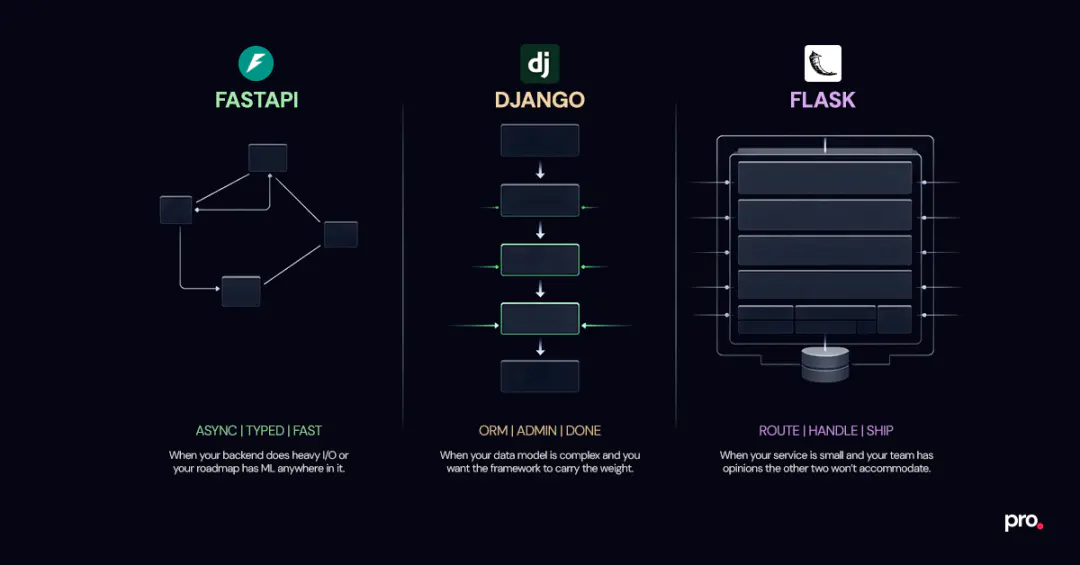
FastAPI, Django, and Flask are all legitimate choices for a Python backend. The problem is that most teams pick one based on the wrong signal: async sounds modern so FastAPI, lightweight sounds safe so Flask, last company used it so Django. None of these are terrible reasons, but none of them are the right questions either.
The right question is how much of the backend infrastructure you want the framework to handle, and whether that matches what you are actually building. FastAPI, Django, and Flask made fundamentally different bets about that. Here is the reasoning behind each.
FastAPI, Django, and Flask: What Each Python Framework Was Built to Solve
These three frameworks do not share the same starting assumption — and that is the actual source of most bad picks. Before you compare feature lists, it helps to understand what each one was designed to optimise for.
FastAPI vs Django vs Flask: At a Glance
FastAPI was designed from the ground up for building APIs fast, with async support and automatic data validation baked in. It uses Python type hints to power request validation via Pydantic and generates OpenAPI documentation automatically. The result: less boilerplate, fewer runtime errors from bad input, and a developer experience that most teams find significantly faster once they are past the initial learning curve. It is built on Starlette under the hood, which means it inherits solid async I/O performance.
Django took the opposite approach. It is an opinionated, batteries-included framework that ships with an ORM, a built-in admin interface, authentication, form handling, migrations, and a project structure that most teams follow without deviation. The philosophy: Django has already made the common decisions so your team does not have to. This is genuinely useful when you are building something with a rich data model and multiple internal stakeholders who need admin access to data.
Flask is the minimalist. It gives you routing and request handling. Everything else is a library you bring in yourself: the ORM, authentication, validation, serialisation. That flexibility is a feature if you have an experienced team and specific architectural requirements. It is a liability if you are moving fast or onboarding people who are not Python-native.
| FastAPI | Django | Flask | |
|---|---|---|---|
| Design philosophy | API-first, async-native | Batteries included | Minimalist, unopinionated |
| Async support | Native (asyncio) | Added in 3.1, not the default | Via extensions (Quart, etc.) |
| Data validation | Built-in via Pydantic | Forms + DRF (if REST) | Manual or via Marshmallow |
| ORM | None built-in (SQLAlchemy, Tortoise) | Built-in (Django ORM) | None (typically SQLAlchemy) |
| Admin interface | None | Built-in | Via Flask-Admin (extension) |
| OpenAPI / Docs | Auto-generated | Via DRF Spectacular | Manual |
| Learning curve | Moderate (type hints, async) | Moderate (Django conventions) | Low (easy to start, complex at scale) |
| Best for | Async APIs, ML inference, microservices | Full-stack web apps, admin-heavy backends | Small services, custom architectures |
When FastAPI Is the Right Choice for Python Backend Development
FastAPI's core advantage for Python backend development is not just speed. It is the combination of async support, automatic validation, and developer tooling in one package.
The async model matters most when your API does a lot of I/O: database calls, external API requests, reading from queues. FastAPI runs on asyncio natively, so you are not retrofitting async onto a synchronous base. A well-structured FastAPI service can handle high concurrency with a lean footprint, which makes it a practical choice for both microservices and standalone APIs that expect variable load.
The Pydantic-based validation is worth calling out separately because it changes the development loop in a concrete way. When you define a request model with types, FastAPI validates the incoming data before it ever reaches your handler function. Bad input is rejected at the boundary, not three function calls deep. That alone reduces a class of bugs that Flask and Django REST Framework both handle less elegantly.
The auto-generated OpenAPI docs are useful beyond just developer convenience. If you work with external teams, or if your API is consumed by a frontend team that needs a live spec, having docs that update in sync with the code removes a coordination overhead that is easy to underestimate.
Where FastAPI fits well:
- Async-heavy APIs with significant external I/O
- ML model serving and inference endpoints (FastAPI is the de facto standard here)
- Microservices that need to be lean and independently deployable
- Teams where backend and frontend are separate and want a clean contract via OpenAPI
- New projects where the team already has Python type hint familiarity
Where it gets harder: FastAPI gives you no ORM, no admin interface, and no enforced project structure. Early architecture decisions that Django would have made for you are now yours to make — and document, so the next engineer is not starting from scratch.
One thing worth flagging before you start: Pydantic v2 (which FastAPI ships with) is not backward-compatible with v1. If your project has any libraries that depend on Pydantic v1, resolve this dependency conflict before the project starts, not mid-sprint when something silently breaks in production. This catches teams more often than it should.
When Django Backend Development Makes More Sense Than FastAPI
Django's reputation for being "slow" compared to FastAPI or Flask is mostly a benchmark artifact. In production, Django handles real load fine. The question for Python backend development is never whether Django can scale. It is whether its architecture fits your product.
If your team is already working on Python backend projects with relational data, admin workflows, or multi-role access, Django's built-in tooling closes that gap faster than any other framework.
The case for Django is strongest when your backend has a rich data model with multiple related entities, business logic that lives close to the data, and internal users who need to view or manage records directly. The Django admin gives you a functional internal interface in the time it takes to register a model. For startups with non-technical co-founders or ops teams who need to act on data without a custom dashboard, this is genuinely valuable and not something you can replicate quickly with FastAPI.
Django's ORM is mature, well-documented, and handles complex queries reasonably well. Migrations are built in and predictable. The authentication system works out of the box. For a team that wants to spend time on product logic rather than infrastructure decisions, Django removes a lot of friction early.
Django REST Framework (DRF) extends Django for API use cases with serialisers, viewsets, and authentication classes. It is more verbose than FastAPI but also more explicit, which some teams prefer when the API surface is large and multiple engineers are working on it simultaneously.
Where Django fits well:
- Full-stack web applications with complex data models
- Products with internal admin requirements
- Teams that want conventions over configuration
- Backends with multi-step user flows, permissions, and role-based access
- Longer-term projects where onboarding consistency matters more than early velocity
Where it gets harder: Django's async support arrived in version 3.1 but was added onto a synchronous core, not built into it. Async views work, but you need to be deliberate about where sync and async code meet. Connection pooling also behaves differently in async Django — if you are not using something like django-db-geventpool or asyncpg properly, you can introduce subtle bottlenecks that are hard to trace under load.
Flask for Python APIs: When Minimal Is the Right Architecture
Flask's strength for Python APIs is its simplicity and composability. You get routing and a request context. Everything else is your choice: SQLAlchemy or another ORM, Marshmallow for serialisation, Flask-Login for auth, or something else entirely. That composability is a real feature when you have a specific architectural requirement that none of the batteries-included frameworks satisfy.
In practice, the teams that get the most value from Flask tend to share a few characteristics: they are experienced, they have strong opinions about their dependencies, and they are building something with unusual structural requirements. A data engineering team building a lightweight internal API on top of a non-standard database. A team migrating from an existing stack who want to preserve parts of their architecture. A service so small and specific that Django would be overkill and FastAPI's async model is irrelevant.
What Flask is not good for: teams that need to move fast and cannot afford to make every decision themselves. The ecosystem of Flask extensions is inconsistent in quality and maintenance. "We can just add what we need" often becomes "we are maintaining six loosely integrated libraries" six months into the project.
Where Flask fits well:
- Small, well-scoped services with specific requirements
- Teams with Python depth who want explicit control over their dependencies
- Prototyping or internal tooling where the production requirements are bounded
- Legacy migration paths where Flask lets you preserve existing patterns
Where it gets harder: Flask has no enforced project layout. What starts as flexibility compounds into inconsistency as the team grows — different engineers make different calls on how to organise blueprints, where to initialise extensions, and how to handle config across environments. You end up writing and maintaining the structure that Django would have given you for free.
How to Choose Between FastAPI, Django, and Flask: The Variables That Actually Hold Up
Choosing a Python web framework by reading feature lists is a bit like choosing a hire by reading a CV. The signal that matters most is fit for the actual work. Four variables tend to determine which choice ages well — and three of them rarely show up in standard framework comparisons.
1. Team experience and type hints familiarity. FastAPI's productivity advantage relies on your team being comfortable with Python type hints. If you are onboarding engineers who come from a Django background or who are relatively new to Python, the FastAPI learning curve is real. Django's conventions are easier to inherit. Flask has the lowest barrier to start but the highest complexity ceiling as the codebase grows.
2. Async requirements. If your service does significant concurrent I/O, FastAPI's native async model is the right fit. Do not choose it purely because async sounds modern — it matters when you actually have the I/O pattern it is optimised for. A standard CRUD backend with one database and no queue processing gets no meaningful benefit from async.
3. Admin and internal tooling needs. If your product will have non-technical users or internal operators who need to view and manage data, Django's admin saves weeks of work. This is the variable most framework comparison posts skip entirely because it is not measurable in benchmarks — but it consistently changes which framework is the right call in practice.
4. ML or AI on the roadmap. If your Python backend will eventually serve model inference, handle vector search, or integrate with LLM frameworks, FastAPI is the ecosystem default. Most ML serving tutorials, LangChain examples, and inference endpoint patterns are written for FastAPI. Starting in Django or Flask and migrating an inference layer later is doable but adds friction you could have avoided at the start.
A quick way to pressure-test the decision: answer these five questions and see where the weight falls.
- What is the primary function of this backend? (CRUD with relational data → Django. High-throughput API with external consumers → FastAPI. Small, scoped service → Flask.)
- What is your team's current confidence with async Python? (High → FastAPI. Low or mixed → Django or Flask, where sync is the default.)
- How much time before the first version needs to work? (Tight → Django or Flask removes the assembly step. More runway → FastAPI's architecture investment pays off later.)
- Does your product need a data management interface for non-technical users? (Yes → Django's admin panel is worth the framework choice by itself.)
- Are you building one application or a fleet of services? (One application → Django's structure is an asset. Multiple small services → Flask or FastAPI's lighter footprint fits better.)
If one framework comes out ahead on three or more questions, that is your answer. If they split evenly: FastAPI is the stronger greenfield default if async and ML are in the picture; Django is the more forgiving default if the team has mixed Python experience and the product needs to move fast.

FastAPI vs Django vs Flask: Decision Table
| Your situation | Recommended framework |
|---|---|
| New async API, no admin requirements | FastAPI |
| ML inference or AI integration endpoints | FastAPI |
| Complex data model, internal admin needed | Django |
| Startup with non-technical co-founders who need data access | Django |
| Multi-engineer team, needs strong conventions | Django |
| Microservice with specific, bounded requirements | Flask or FastAPI |
| Experienced team, unusual architectural needs | Flask |
| Greenfield project, team has no strong preference | FastAPI |
| REST API on top of existing Django app | Django + DRF |
| High-concurrency API, I/O-heavy with no admin needs | FastAPI |
The clearest signal: if your backend will touch ML or AI in any meaningful way, start with FastAPI. The inference ecosystem is built around it and the async model aligns with how model serving actually works in production.
Can You Use Django and FastAPI Together? When the Answer Is Yes
The question comes up in enough real Python backend projects to address directly: can you run Django and FastAPI in the same system?
Yes, and it is not a fence-sitting answer. A common pattern: Django handles the main application, auth, and admin. FastAPI runs alongside it as a dedicated layer for high-performance async endpoints, ML inference results, or webhook processing. Both run as separate services sharing a database or communicating over internal HTTP.
This works well when the requirements genuinely pull in different directions. If 90% of your backend is data management with admin workflows, and 10% is high-concurrency async processing, building that 10% in FastAPI while keeping Django for the rest is more sensible than rebuilding everything in FastAPI and losing the admin panel, or forcing async patterns into Django everywhere.
The tradeoff is real: two frameworks means separate deployment configs, separate dependency chains, and an on-call rotation that now spans two different mental models. Worth it when requirements genuinely pull in different directions. Not worth it as a hedge against a decision you have been avoiding.
Common Python Framework Mistakes Engineering Teams Make
After working on Python backend development across fintech, healthtech, and B2B SaaS products, a few patterns come up consistently:
Starting with Flask "for simplicity" and outgrowing it faster than expected. Flask is fast to start. At medium scale, the absence of structure starts costing more time than the simplicity saves. Teams end up enforcing conventions manually that Django or FastAPI would have given them for free. If you are building something you expect to grow, Flask is usually the wrong starting point unless you have a specific reason for it.
Choosing Django when async I/O is the core requirement. Django's async support is real, but there is a subtler problem that teams hit in production: the ORM itself is synchronous. Even if you write async views, any database query blocks the event loop unless you are using sync_to_async wrappers or switching to an async-native ORM like Tortoise. Teams that pick Django for a high-concurrency API and assume they can just add async views later end up doing a more significant refactor than they expected.
Treating FastAPI as a drop-in replacement for Django. The gap is not just missing features — it is missing conventions. Django projects across different companies tend to look structurally similar. FastAPI projects do not. If you bring in a new engineer mid-project, they are reading your specific decisions rather than applying shared knowledge. That is fine for a small, stable team. It becomes a real cost at scale or during onboarding.
Not accounting for team turnover. This one costs more than teams expect. A highly customised Flask setup is the hardest to hand off: the next engineer has to reverse-engineer every dependency choice the previous team made, and there is no shared mental model to fall back on. Django's conventions mean a mid-level Python developer can get oriented in a day even without a handoff call. FastAPI sits between them — the type hints are self-documenting, but the project structure is something you have to define, document, and enforce yourself. If your team turns over frequently, that maintenance overhead is real.
If you are scaling a Python backend and considering bringing in external engineers, our Python staff augmentation work covers exactly this: senior engineers who can step into FastAPI, Django, or Flask codebases without a long ramp-up.
Wrapping Up: FastAPI vs Django vs Flask
All three frameworks are actively maintained, production-proven, and used in systems you rely on daily. The question was never which one is best. It was which one fits the kind of system you are building, the team you have, and the constraints you are working within.
Use FastAPI when your backend is async-heavy, ML-adjacent, or needs a clean OpenAPI contract for external consumers.
Use Django when you have a complex data model, internal users who need admin access, or a team that ships faster with conventions in place.
Use Flask when the service is small, the requirements are unusual, and your team has a specific reason to own every dependency choice.
The framework debate tends to run longest in teams that are actually wrestling with a harder question: what are we building, who is building it, and how fast do we need to ship. Getting clear on those first usually makes the framework choice obvious.
If you want a straight read on what fits before you commit, our Python engineers are easy to reach.
Procedure Team
Engineering Team
Expert engineers building production AI systems.