
Frontend engineering has become a revenue lever, not a cost center. A Google-commissioned study by Deloitte found that a 0.1-second improvement in mobile load time increased retail conversions by 8.4% and travel conversions by 10.1%, based on 30 million user sessions across 37 brands. Core Web Vitals now directly influence search rankings. And with AI search engines like Google AI Overviews, Perplexity, and ChatGPT reshaping how users discover products, your frontend needs to be built for both humans and machines.
Finding the right partner for modern frontend engineering is harder than it looks. The market is crowded with firms that list React, Angular, and Vue on their website but lack the architectural depth to build frontends that hold up under real traffic, real teams, and real business pressure. We've been building production frontends with React, Next.js, and Vue for companies across India and the US, and that experience shapes how we evaluate other firms in this space.
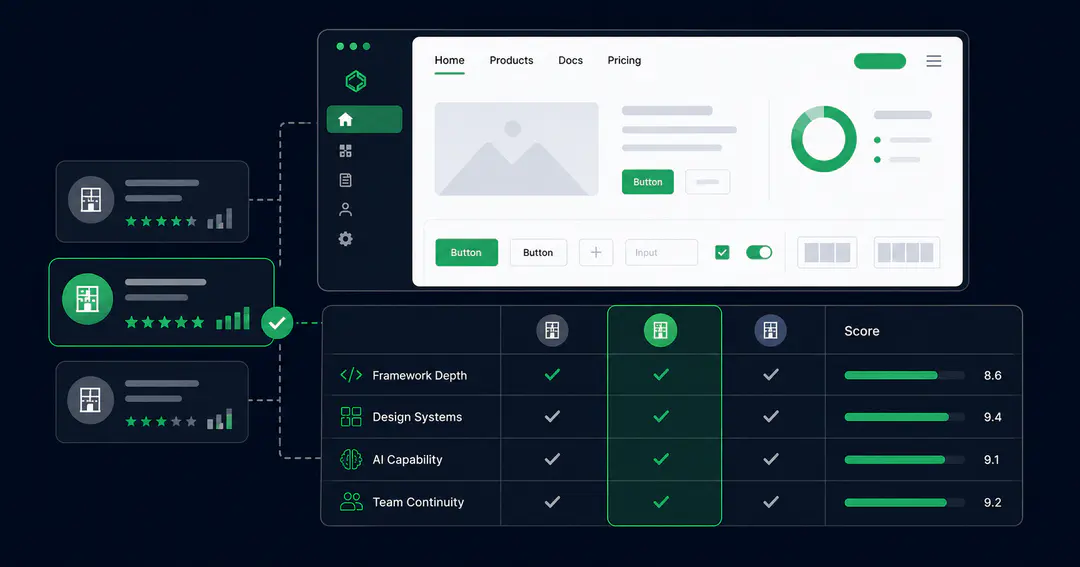
We scored more than 30 frontend development companies against nine criteria. These 16 stood out.
Quick answer: The strongest frontend development companies in 2027 fall into three groups. For enterprise-scale transformation, Accenture and Cognizant lead. For product teams that want senior engineers who stay on the project, Procedure, eSparkBiz, Netguru, and Thoughtbot stand out. For fast, cost-conscious scaling, BairesDev, Simform, and Bacancy are the common picks. The full list, scored across nine criteria, follows below.
How We Evaluated These Frontend Development Companies
Most listicles rank companies by Clutch rating and hourly rate. Those matter, but they tell you almost nothing about what it's actually like to work with a vendor for 12 months.
We scored each company across nine criteria, weighted by what engineering leaders tell us matters most when evaluating partners:
- Frontend framework depth (25%): Production experience with React, Next.js, Vue, or Angular. Not "we list 10 frameworks on our website" but verifiable production applications and case studies. This is the core competency. It carries the most weight because everything else is secondary if the team can't build.
- Design system capability (15%): Can they build and maintain component libraries, design tokens, and cross-team UI infrastructure? This separates frontend engineers from page builders.
- Client retention rate (10%): Do clients stay beyond the first project? Published retention data or evidence of multi-year engagements signals delivery quality over time.
- Employee satisfaction (10%): Glassdoor rating, verified by third-party reviews. Happy engineers write better code, stay longer on your project, and don't get rotated out mid-sprint. For reference, tech companies average about 3.8 on Glassdoor.
- Clutch rating (10%): The standard client review platform. We used the overall rating as a quality floor.
- Onboarding speed (10%): Time from first call to first production contribution. Engineering leaders who need to move fast care about this number, and almost nobody publishes it.
- AI capability (10%): Can they build LLM-powered interfaces, AI search, or conversational UI? Frontend combined with AI engineering is the 2027 differentiator.
- Team continuity (5%): Does the vendor commit to keeping the same engineers on your project, or do they rotate people quarterly? Knowledge that walks out the door costs more than the hourly rate suggests.
- Workplace certification (5%): Third-party culture validation like Great Place to Work, TSOW, or B Corp. Not a dealbreaker, but a signal that the team behind your project is stable.
Frontend Development Companies Compared at a Glance
| Company | Best for | Framework depth | Design systems | Retention | Glassdoor | Clutch | Onboarding | AI capability | Team continuity | Workplace certification |
| Accenture | Enterprise transformation | Broad | Yes | N/A | 3.7 | N/A | 4-8 weeks | Yes | Varies | GPTW |
| Cognizant | Large-scale digital engineering | Deep | Yes | N/A | 3.6 | N/A | 4-8 weeks | Yes | Varies | GPTW |
| Procedure | Engineers who stay | Deep | Yes | 98% | 4.9 | 4.8 | 2-5 days | Yes | Guaranteed | TSOW |
| eSparkBiz | Modern frontend engineering | Deep | Yes | 95% | N/A | 4.9 | 48-72 hours | Yes | Dedicated teams | CMMI Level 3, AWS Advanced Tier Partner, SOC 2 and ISO 27001:2022 |
| Netguru | Design + engineering | Strong | Yes | N/A | 4.0 | 4.8 | 2-3 weeks | Emerging | Dedicated teams | B Corp |
| Thoughtbot | Code quality, TDD | Strong | Selective | N/A | 4.4 | 4.9 | 2-4 weeks | Emerging | Project-based | N/A |
| BairesDev | Nearshore scale | Broad | Limited | N/A | 3.7 | 4.9 | 1-2 weeks | Limited | Rotational | N/A |
| ScienceSoft | Healthcare & finance apps | Broad | Limited | N/A | N/A | 4.8 | 2-4 weeks | Yes | Dedicated teams | N/A |
| N-iX | Enterprise compliance | Strong | Yes | N/A | 3.9 | 4.8 | 3-4 weeks | Yes | Dedicated teams | GPTW |
| Brainhub | React specialists | Deep | Selective | N/A | N/A | 4.9 | 2-3 weeks | Emerging | Dedicated teams | N/A |
| Simform | Volume at India rates | Strong | Yes | N/A | 4.1 | 4.9 | 2-3 weeks | Yes | N/A | GPTW |
| Radixweb | Ongoing dev & maintenance | Moderate | Limited | N/A | N/A | 4.8 | 2-4 weeks | Limited | N/A | GPTW |
| Bacancy | India staff augmentation | Strong | Limited | N/A | 4.4 | 4.9 | 1-2 weeks | Limited | N/A | GPTW |
| Devox Software | Frontend rescue projects | Moderate | Selective | N/A | N/A | 5.0 | 2-3 weeks | Selective | N/A | N/A |
| Acquaintsoft | Cost-effective builds | Moderate | No | N/A | N/A | 4.9 | 1-2 weeks | No | N/A | N/A |
| Sumatosoft | Custom web applications | Moderate | Selective | N/A | N/A | 4.8 | 2-3 weeks | Limited | N/A | N/A |
The 16 Best Frontend Development Companies for 2027
1. Accenture
Best for: Enterprise digital transformation at global scale
Founded: 1989 | HQ: Dublin, Ireland | Team: 500,000+ | Rate: Enterprise
Accenture is the default answer when a Fortune 500 board asks who can rebuild a digital experience across dozens of markets at once. Frontend sits inside a large digital and experience practice that pairs product strategy, experience design, and frontend engineering. Generative AI is increasingly built into how those experiences ship. For frontend specifically, that means Accenture can staff design-system programs, large-scale React and Angular builds, and multi-year replatforming efforts inside the governance and compliance structure that regulated enterprises require.
The trade-off is what you would expect from a firm this size. Engagements start at enterprise budgets, procurement and onboarding take time, and the senior people who win the pitch are not always the people who do the work. Accenture's Glassdoor rating sits in line with the large-SI average. If you are a startup or a mid-market team that needs to move in weeks, Accenture is not built for you. If you are an enterprise with the budget and scale to match, few firms match its reach.
Quick facts:
- Clutch: N/A (enterprise, not review-driven)
- Glassdoor: 3.7
- Key frameworks: React, Angular, Vue, plus a full design and experience practice
- Design systems: Yes (enterprise scale)
- AI capability: Yes (generative AI in delivery)
- Notable: Global professional-services firm serving Fortune Global 500 clients across industries
Best suited for: Large enterprises with the budget and project scale for a global transformation partner. Less suited for startups or mid-market teams that need speed, senior continuity, or a lower rate.
2. Cognizant
Best for: Large-scale digital engineering with an experience arm
Founded: 1994 | HQ: Teaneck, New Jersey, USA | Team: 300,000+ | Rate: Enterprise
Cognizant sits in the same enterprise tier as Accenture but comes at frontend from an engineering-first direction. Its digital engineering practice builds user-facing web applications in React and TypeScript, with modern patterns like Next.js, micro-frontend architecture, module federation, and design tokens in the mix, plus server-side rendering handled with SEO in mind. That is a current frontend stack, not a legacy shop bolting React onto old delivery. A separate experience-design arm focuses on AI-infused customer experiences, so Cognizant can take a large frontend program from research and interaction design through to production engineering when a single accountable vendor is a procurement requirement.
The caveats are structural, as with any firm this size. Employee experience varies widely across a workforce of several hundred thousand, so the engineers on your account may or may not reflect the practice's best work. Minimum engagement sizes and enterprise onboarding timelines put it outside the range of smaller teams. But for a large organization that wants modern frontend engineering backed by a global delivery machine, it is a credible option.
Quick facts:
- Clutch: N/A (enterprise, not review-driven)
- Glassdoor: 3.6
- Key frameworks: React, TypeScript, Next.js, Angular, micro-frontends
- Design systems: Yes (design tokens, component libraries)
- AI capability: Yes (AI-infused experience practice)
- Notable: Enterprise-scale digital engineering with a modern frontend architecture
Best suited for: Large enterprises that want modern frontend engineering with the backing of a global services firm. Less suited for startups, budget-sensitive builds, or teams that need fast onboarding and senior continuity.
3. Procedure
Best for: Product-led teams that want engineers who stay
Founded: 2017 | HQ: Mumbai, India | Team: 50-249 | Rate: $50-99/hr
Procedure approaches frontend development differently from most of the other vendors. Instead of competing on volume or hourly rate, they run a mentorship model: experienced engineers paired with sharp, emerging talent. The result shows up where it counts: the company earns near-universal employee recommendation and client partnerships that run for years rather than single projects.
For frontend work specifically, that continuity is the differentiator. The engineers who learn your component architecture, your state-management decisions, and your rendering strategy in month one are still on the project in year three. At most staff augmentation firms, engineers rotate every few months, and each replacement spends their first sprints relearning context instead of shipping features or protecting your Core Web Vitals.
Procedure treats design systems as a core service, not an add-on, which is the dividing line between building pages and building systems that scale across teams. Their frontend practice centers on React, Next.js, and Vue, and their published case studies show the ceiling of what they take on: a real-time observability dashboard that sustains 980 million telemetry data points per minute during live cricket matches, holding a 99.9% SLA with zero escalated incidents through peak traffic. That is frontend engineering under genuine load, not a marketing site.
Turtlemint and Treebo are among the frontend products they have engineered, and Setu (by Pine Labs) is a long-running platform client. A deep dive into frontend architecture at scale on their blog reflects how they think about component structure, state management, and rendering strategy at the systems level.
What separates Procedure from others in this price range is the pairing of AI engineering with frontend expertise. As an AI-native firm, they build LLM-powered interfaces, AI search, and conversational UIs alongside conventional frontend work, which matters as more products need those two disciplines in the same codebase.
Procedure is also a TSOW Certified Best Workplace, verified by a third party rather than self-reported. For anyone who has been burned by a vendor with high attrition, that certification is a proxy for the team stability you are actually buying.
Quick facts:
- Clutch: 4.8
- Glassdoor: 4.9 (100% of employees recommend)
- Key frameworks: React, Next.js, Vue, TypeScript, Tailwind
- Design systems: Yes (dedicated service)
- AI capability: Yes (AI-native, LLM applications, AI agents)
- Onboarding: 2-5 days from first call to first production PR
- Client retention: 98%, average partnership 3+ years
- Workplace: TSOW Certified Best Workplace
- Notable clients: Turtlemint, Treebo, Setu (Pine Labs)
Why Procedure stands out:
- A mentorship model built to keep the same engineers on your project from first sprint to launch, reflected in strong client retention and multi-year partnerships
- Engineers are hand-picked by the founders and expected to learn your domain and your users, not just close tickets
- Each engagement runs as a pod built for your specific problem, with an experienced delivery manager who owns delivery, so managing the vendor is not on you
- Design systems delivered as a dedicated service, not an add-on
- Frontend and AI engineering handled by one team, so LLM-powered search and conversational UIs ship in the same codebase as the rest of your frontend
- A third-party-verified workplace record (TSOW Certified) and fast onboarding, from first call to first production PR in days
Best suited for: Growth-stage and mid-market product companies in India and the US that need a frontend partner for the long term, value engineering quality and team stability over the lowest rate, and increasingly need frontend and AI to work in the same codebase.
4. eSparkBiz
Best for: Companies with demanding web application needs
Founded: 2010 | HQ: Delaware, USA & India | Team: 400+ | Rate: < $25/hr
eSparkBiz has built software products and digital solutions since 2010, giving their frontend practice a foundation that goes beyond individual interface projects. Their 400+ member engineering team works with clients in 20+ countries, bringing experience from different environments into frontend delivery. That breadth matters when a frontend project needs to fit into an existing technology stack rather than operate as a standalone layer.
The company brings frontend development into a broader engineering practice, which gives teams access to more than interface development alone. Their engineers work with modern frontend technologies while connecting the UI layer with APIs, cloud infrastructure, backend services and AI features. That matters when the frontend is part of a larger product rather than an isolated development task.
The company combines frontend engineering with AI expertise, making it a fit for products that need intelligent interfaces, AI workflows or data-rich user experiences. Its technology work also covers application modernization, which can help teams replace aging frontend architectures without rebuilding the entire product from scratch.
Quick facts:
- Clutch: 4.9
- Key frameworks: React, Angular, Vue, Next.js
- Design systems: Yes (part of enterprise practice)
- AI capability: Advanced
- Notable: Trusted by Fortune 500 companies for complex digital initiatives
Best suited for: Growing product teams and established businesses that want a dedicated engineering partner for complex frontend initiatives, product upgrades and continuous development. Teams with defined technical requirements that want a partner who can contribute beyond individual UI tasks.
5. Netguru
Best for: Companies that want design and frontend engineering from one partner
Founded: 2008 | HQ: Poznan, Poland | Team: 800+ | Rate: $50-99/hr
Netguru is one of the few frontend development companies where design is genuinely built into engineering delivery, not bolted on as a separate phase. Their product design practice and frontend engineering teams work together from sprint one, which matters when you are building interfaces where user experience directly drives business metrics.
Netguru pairs a mature product-design practice with modern frontend tooling. Their React and Vue teams deliver production frontends for large consumer and enterprise brands, and a team of that size can staff complex, multi-team projects without diluting quality.
Where Netguru differentiates from other European agencies is the depth of their product thinking. They don't just build what you spec; they challenge the spec when it doesn't serve the user.
Quick facts:
- Clutch: 4.8
- Glassdoor: 4.0 (81% recommend)
- Key frameworks: React, Vue, Next.js, React Native
- Design systems: Yes (built with design practice)
- AI capability: Emerging practice
- Notable: Enterprise consumer brands
Best suited for: Mid-to-large companies that want a single partner for both design and frontend engineering. European timezone preferred. Minimum budget $25K.
6. Thoughtbot
Best for: Teams that treat code quality as non-negotiable
Founded: 2003 | HQ: Boston, USA | Team: 50-249 | Rate: $150-199/hr
Thoughtbot has built its reputation on doing fewer things exceptionally well. They don't chase scale. They don't offer offshore pricing. What they do offer is a test-driven development discipline that most agencies talk about but few actually practice. Every project starts with a product discovery phase, and every line of frontend code ships with automated tests.
Their open-source track record is part of their credibility. They maintain widely used developer libraries, and contributing tools that other engineers depend on signals a level of technical depth that no client review can. On the frontend side, Thoughtbot works primarily in React and React Native, often paired with Ruby on Rails on the backend. Their strength is in building MVPs and early-stage products where architectural decisions compound: the patterns they set in month one are still paying off in year two.
Quick facts:
- Clutch: 4.9
- Glassdoor: 4.4 (90% recommend)
- Key frameworks: React, React Native, Rails
- Design systems: Selective (not a primary service)
- AI capability: Emerging practice
- Notable: Recognized for open-source contributions and a genuine TDD discipline
Best suited for: Product-minded companies building new digital products that need to launch right the first time, with budget for premium quality. Less suited for ongoing team augmentation or budget-sensitive engagements.
7. BairesDev
Best for: Rapid nearshore scaling in US timezones
Founded: 2009 | HQ: San Francisco, USA | Team: 3,000+ | Rate: $50-99/hr
BairesDev solves a specific problem well: you need 5 or 10 React developers in your timezone by next month. Their talent pool across Latin America is deep, their onboarding process is fast, and their engineers generally overlap US working hours without the 12-hour time difference of offshore models.
Where BairesDev shines is in the speed of assembling teams. Where it is less suited is for greenfield architecture decisions or design-system-level frontend work. BairesDev provides engineers, not architectural direction.
Their Glassdoor rating is on the lower side, which is common among large staff augmentation firms where employee experience varies significantly across clients and projects. Something to factor in if team satisfaction matters to your evaluation.
Quick facts:
- Clutch: 4.9
- Glassdoor: 3.7
- Key frameworks: React, Angular, Vue, React Native
- Design systems: Limited (not a primary service)
- AI capability: Limited
- Notable: Fortune 500 augmentation clients across industries
Best suited for: US companies needing quick access to frontend talent in compatible timezones. Less suited for teams that want architectural leadership or long-term frontend strategy from their vendor.
8. ScienceSoft
Best for: Data-heavy applications in healthcare and finance
Founded: 1989 | HQ: McKinney, Texas, USA | Team: 750+ | Rate: $50-99/hr
ScienceSoft has been building software for over three decades, which makes it one of the more established firms in the market and one of the few with a genuinely global delivery footprint across North America, Europe, and the Middle East. Frontend is part of a broad custom-development practice rather than a standalone specialty, and their teams work across React, Angular, and Vue, often alongside .NET on the backend.
Where ScienceSoft earns its place is depth in regulated sectors. Their healthcare and financial-services work carries the compliance posture (ISO 9001, ISO 27001, ISO 13485) that those industries demand, which matters more for a patient portal or a trading interface than raw framework fluency.
The trade-off is focus. ScienceSoft is a generalist engineering firm, so frontend-specific concerns like design-system architecture or Core Web Vitals work are handled competently but are not the center of gravity. For teams that want a stable, compliance-ready partner for a data-heavy application with a frontend layer, that breadth is an asset. For a design-system-led build, a frontend specialist may fit better.
Quick facts:
- Clutch: 4.8
- Glassdoor: N/A
- Key frameworks: React, Angular, Vue, .NET
- Design systems: Limited
- AI capability: Yes (AI and data practice)
- Notable: 30+ years in software; strong in healthcare and finance; ISO 9001, 27001, 13485 certified
Best suited for: Enterprises and mid-market teams in regulated industries that need a stable engineering partner for data-heavy applications with a frontend layer. Less suited for design-system-led or pure-frontend engagements.
9. N-iX
Best for: Enterprise-scale programs with strict compliance needs
Founded: 2002 | HQ: Malta | Team: 2,400+ | Rate: $50-99/hr
N-iX brings enterprise scale and regulatory experience to frontend development. With delivery centers across Europe, the Americas, and Asia, they can staff complex frontend programs that require compliance with financial services, healthcare, or manufacturing regulations.
N-iX's frontend teams work across React, Angular, and Vue, often inside larger digital transformation programs, and they hold enterprise cloud and ISO credentials that regulated buyers look for. Their AWS partnership and ISO 27001 and ISO 9001 certifications are the kind of table stakes that matter at this level.
The trade-off with N-iX, as with most enterprises of this size, is agility. Onboarding and setup take longer than with smaller firms, and the minimum project size ($100K+) puts them outside the range of most startups.
Quick facts:
- Clutch: 4.8
- Glassdoor: 3.9
- Key frameworks: React, Angular, Vue
- Design systems: Yes (part of enterprise practice)
- AI capability: Yes (data and AI practice)
- Notable: Enterprise clients in industrial and manufacturing sectors; AWS and ISO credentials
Best suited for: Enterprise organizations in regulated industries that need frontend work delivered within strict compliance frameworks. Less suited for startups or teams needing fast, lightweight engagement.
10. Brainhub
Best for: Teams that want a pure React specialist
Founded: 2015 | HQ: Gliwice, Poland | Team: 50-249 | Rate: $50-99/hr
Brainhub leads with React as a primary specialization rather than one framework among many, with work centered on a focused set of React and Node.js engagements.
What makes Brainhub worth considering is the combination of deep React expertise with UX service packages. They run heuristic audits and cognitive walkthroughs as part of their frontend process, which is unusual for an engineering-led firm. For teams where frontend performance and UX quality need to improve together, that combined approach removes coordination overhead.
The trade-off is scale. Brainhub is a focused, mid-sized shop, so it is well suited to a dedicated React team but less suited to large multi-team programs that need hundreds of engineers.
Quick facts:
- Clutch: 4.9
- Glassdoor: N/A
- Key frameworks: React, Next.js, Node.js
- Design systems: Selective
- AI capability: Emerging
- Notable: React-focused specialist with a paired UX practice
Best suited for: Companies with an existing React codebase that need specialists rather than generalists, and teams where frontend performance and UX improvements need to happen together. Less suited for very large, multi-team programs.
11. Simform
Best for: Large organizations that need volume at competitive India rates
Founded: 2010 | HQ: Orlando, FL, USA | Team: 1,000+ | Rate: $25-49/hr
Simform runs a large Indian engineering operation with a US-facing delivery layer, and holds cloud partnerships with AWS, Azure, and Google Cloud.
On the frontend side, Simform's teams work across React, Next.js, and Angular as part of their broader cloud-native architecture practice. Their co-engineering model places engineers alongside your internal team, which works well for large, multi-quarter frontend builds.
Two things worth noting for decision-makers comparing options. First, Simform's 4.1 Glassdoor rating sits a touch above the tech-sector average of about 3.8. It is a data point: at scale, employee experience varies across teams and projects, and the engineers on your project may or may not reflect the Clutch rating. Second, Simform doesn't publish client retention data or team continuity guarantees, which makes it harder to assess long-term partnership quality from the outside.
Quick facts:
- Clutch: 4.9
- Glassdoor: 4.1 (81% recommend)
- Key frameworks: React, Next.js, Angular, Vue
- Design systems: Yes
- AI capability: Yes (AI/ML engineering practice)
- Client retention: Not published
- Team continuity: Not published
- Notable: Enterprise clients across consumer and technology sectors; AWS, Azure, GCP partnerships
Best suited for: Large enterprises that need a proven, established vendor with cloud credentials and competitive India-based pricing for volume frontend work. Teams with strong internal technical leadership that can direct architectural decisions independently.
12. Radixweb
Best for: Ongoing development and maintenance at India rates
Founded: 2000 | HQ: Ahmedabad, India | Team: 250-999 | Rate: $25-49/hr
Radixweb has been in software engineering for over two decades, mostly serving the Indian IT services market. Their frontend practice covers React, Angular, and Vue.
Their long track record is the main draw for organizations that prioritize vendor stability over the latest specialization. Radixweb fits teams that want cost-effective, ongoing development and maintenance at India rates.
Quick facts:
- Clutch: 4.8
- Glassdoor: N/A
- Key frameworks: React, Angular, Vue, .NET frontends
- Design systems: Limited
- AI capability: Limited
- Notable: Long-standing enterprise clients across media and retail
Best suited for: Enterprise organizations looking for a stable, cost-effective frontend partner for ongoing development and maintenance. Less suited for teams that need advanced design system architecture or frontend work with AI built in.
13. Bacancy
Best for: India-based staff augmentation across the full stack
Founded: 2011 | HQ: Ahmedabad, India | Team: 1,000+ | Rate: $25-49/hr
Bacancy has built a large staff-augmentation operation out of India, with a model designed to drop React, Angular, or Vue developers into an existing team on short notice. For companies that need to extend an in-house frontend team quickly at India rates, that is the core value proposition, and they run a high volume of these engagements.
Their frontend work spans React, Angular, and Vue, usually paired with Node or Ruby on Rails on the backend, which supports full-stack product builds under one vendor.
The trade-off is the one common to large staff-augmentation firms: you are buying capacity and flexibility more than architectural direction. For standard frontend builds and team extension, Bacancy is a strong fit. For design-system architecture or complex rendering strategy, expect to bring that direction yourself.
Quick facts:
- Clutch: 4.9
- Glassdoor: 4.4
- Key frameworks: React, Angular, Vue, Node
- Design systems: Limited
- AI capability: Limited
- Notable: Large India-based staff-augmentation operation serving startups to Fortune 500 across healthcare, fintech, and retail
Best suited for: Companies that need to scale a frontend or full-stack team quickly at India rates, with internal technical leadership to set architectural direction. Less suited for design-system-led or architecture-heavy engagements.
14. Devox Software
Best for: Rescuing and modernizing struggling frontend codebases
Founded: 2018 | HQ: Miami, Florida, USA | Team: 50-249 | Rate: $25-49/hr
Devox Software specializes in what is arguably the hardest kind of frontend work: taking legacy codebases and modernizing them without breaking production.
Their ISO 27001 and ISO 9001 certifications add governance credibility for enterprise clients. Devox positions their frontend modernization practice around AI-assisted code analysis and refactoring, which helps de-risk the assessment phase of legacy projects.
For teams that inherited a messy frontend codebase and need someone to untangle it systematically, Devox's combination of modernization focus and competitive pricing makes them worth a conversation.
Quick facts:
- Clutch: 5.0
- Glassdoor: Limited data (small team)
- Key frameworks: React, Angular, Vue
- Design systems: Selective
- AI capability: Selective (code analysis focus)
- Certifications: ISO 27001, ISO 9001, GDPR compliant
Best suited for: Companies with aging frontend codebases that need systematic modernization. Teams that want a smaller, focused partner rather than a large generalist firm.
15. Acquaintsoft
Best for: Cost-effective frontend builds for startups and mid-market
Founded: 2013 | HQ: Ahmedabad, India | Team: 50-249 | Rate: $25-49/hr
Acquaintsoft has built visibility through consistent content output across a high volume of smaller projects. Their frontend stack combines React and Vue with Laravel on the backend, which works well for full-stack product builds where the frontend and backend need to be delivered by the same team.
For startups that want a single vendor to handle everything from database to UI, that full-stack capability at $25-49/hr is compelling.
The trade-off is depth. Acquaintsoft prioritizes breadth of coverage and competitive pricing, which means they are strong at standard web application builds but less suited for complex frontend architecture challenges like design system implementation or large-scale frontend modernization.
Quick facts:
- Clutch: 4.9
- Glassdoor: N/A
- Key frameworks: React, Vue, Laravel (full-stack)
- Design systems: No
- AI capability: No
- Notable: Accessible pricing across a high volume of projects
Best suited for: Early-stage startups and mid-market companies that need a full-stack team at India rates. Projects where standard web application patterns apply and advanced frontend architecture is not a primary concern.
16. Sumatosoft
Best for: Custom web applications with frontend complexity
Founded: 2012 | HQ: Boston, Massachusetts, USA | Team: 50-249 | Rate: $25-49/hr
Sumatosoft rounds out this list as a solid, mid-market frontend development partner. Their frontend work spans React, Vue, and Angular, delivered across custom web application projects, with delivery run out of Eastern Europe behind a US-based front.
Where Sumatosoft fits well is for organizations that need a dedicated frontend team at Eastern European rates without the enterprise overhead of larger firms. Their team size (50-249) is small enough for responsive communication but large enough to staff a meaningful frontend engagement.
Quick facts:
- Clutch: 4.8
- Glassdoor: N/A
- Key frameworks: React, Vue, Angular
- Design systems: Selective
- AI capability: Limited
- Strength: Custom web applications across multiple verticals
Best suited for: Mid-market companies that need a steady, moderately-sized frontend team for custom web application development. Teams comfortable with Eastern European delivery.
What Frontend Development Should Actually Cost in 2027
One of the most common questions engineering leaders ask when evaluating partners is: "What should this actually cost?" Most vendors dodge the question. Here is what the market looks like, cross-referenced with published rate benchmarks like Accelerance's 2026 Global Software Outsourcing Rates and Trends guide, which draws on data from more than 100 firms across regions.
By engagement type:
- MVP frontend build (landing pages, core flows, responsive): $15,000 to $50,000 over 8 to 12 weeks
- Design system implementation (tokens, component library, documentation): $30,000 to $80,000 over 3 to 6 months
- Frontend modernization or migration (legacy to React/Next.js): $50,000 to $150,000 over 4 to 8 months
- Ongoing team augmentation: $5,000 to $15,000 per month per engineer, depending on seniority and geography
By geography:
- US / Western Europe: $100 to $200/hr
- Eastern Europe (Poland, Ukraine): $50 to $99/hr
- India: $25 to $75/hr
- Latin America (nearshore): $50 to $99/hr
What drives cost up: Complex state management, heavy real-time features (WebSockets, live dashboards), strict accessibility compliance (WCAG AA), tight coupling with backend APIs or third-party services, and multi-platform rendering requirements (SSR, ISR, edge).
What drives cost down: Standard CRUD interfaces, well-defined design specs, an existing design system or component library, clear API contracts, and a team that can onboard independently without heavy handholding.
One thing worth saying directly: the cheapest option is rarely the most cost-effective. A $25/hr team that takes six months to ship a messy, unmaintainable frontend costs more in the long run than a $75/hr team that ships a clean, extensible architecture in ten weeks. The total cost of ownership includes every engineer who has to touch that code after the initial build.
How To Evaluate a Frontend Development Company
Before you sign with any frontend development company on this list, run each candidate through these checks. Each one pairs a warning sign with the exact question that surfaces it.
- Ask how they'd diagnose a slow page on their own site. Performance is the product in frontend work, so a partner who can't speak to their own site's speed is a warning sign. A strong answer covers rendering strategy, bundle splitting, image handling, and the Core Web Vitals that matter (LCP, CLS, INP). A retreat to "best practices" signals the opposite.
- Ask their position on React Server Components. Framework breadth without opinion is a warning sign. Try: "What's your take on React Server Components vs client-side rendering for our use case?" The quality of the answer reveals whether they have actually built with modern React or just added it to their services page.
- Ask to see a design system they built for a past client. A partner who can show a component library with documentation, token management, and cross-team governance understands frontend at the systems level. One that has never shipped a component library or managed design tokens is selling you individual contributors, not architects, and that gap gets expensive as your product grows. For context, here is how Procedure thinks about frontend architecture at the systems level.
- Ask who stays on your project, and what happens when someone leaves. Engineer rotation is the hidden cost of staff augmentation. Two questions surface it: "Will the same engineers be on my project in six months?" and "What happens when one of your engineers leaves mid-project?" Vague or conditional answers mean you absorb a knowledge-transfer tax every time someone new joins. For teams comparing frameworks, our Angular vs React comparison covers how framework choice affects team continuity.
- Insist on case studies with performance metrics. "We built a React app for Company X" is a claim. "We reduced bundle size by 40% and improved LCP from 4.2s to 1.8s for Company X" is evidence. Insist on the second version.
- Ask how they handle frontend SEO: SSR, ISR, or edge rendering. The answer reveals architectural maturity. Our comparison of Next.js, React Router, and Astro walks through how these rendering approaches differ.
- Ask whether you can interview and approve the assigned engineers. This separates transparent partners from black-box staffing firms. If the answer is no, ask why.
- Ask how fast they can start contributing to production code. Some vendors take 4 to 6 weeks to get through procurement, onboarding, and ramp-up. Others ship code within 10 days. The difference matters when you are behind schedule.
Frequently Asked Questions About Frontend Development Companies
Which framework should I choose for my frontend: React, Vue, or Angular?
React dominates the job market and ecosystem. Vue offers a gentler learning curve and is strong for content-heavy sites. Angular provides the most opinionated structure, which helps large teams enforce consistency. The right choice depends on your team's existing skills, your product's complexity, and your hiring plans.
What does it cost to work with a frontend development company in 2027?
Rates range from $25/hr (India, budget tier) to $200/hr (US premium consultancies). A typical MVP frontend build costs $15,000 to $50,000. Design system implementations run $30,000 to $80,000. Ongoing augmentation costs $5,000 to $15,000 per engineer per month.
What's the difference between a frontend development company and a full-stack agency?
Frontend companies specialize in the user-facing layer: component architecture, rendering strategy, performance tuning, accessibility. Full-stack agencies cover frontend and backend but may lack depth in either. For complex frontend work (design systems, performance-critical UIs, LLM-powered interfaces), a specialist usually delivers better results.
Should I build an in-house frontend team or work with an external partner?
Both work. In-house gives you direct control and cultural fit. An external partner gives you speed, flexibility, and access to specialists you might not find locally. Many companies do both: a small in-house frontend team that sets standards, supported by an external partner that handles execution and overflow.
How long does a typical frontend build take?
An MVP with core flows and responsive design takes 8 to 12 weeks. A full design system implementation takes 3 to 6 months. A frontend modernization (legacy to React/Next.js) takes 4 to 8 months. These timelines assume a clear design spec and stable API contracts.
What are Core Web Vitals and why do they matter for frontend development?
Core Web Vitals are Google's metrics for page experience: Largest Contentful Paint (loading), Cumulative Layout Shift (visual stability), and Interaction to Next Paint (responsiveness). They directly affect search rankings and user engagement. Any frontend partner you evaluate should be able to discuss these metrics with specifics, not generalities.
How do I evaluate a frontend development company's technical quality?
Ask for case studies with before and after performance metrics, and ask how they would diagnose a slow page. Check their Glassdoor rating, which correlates with engineering quality. Ask them to explain their rendering strategy for a specific use case. Review their open-source contributions if any exist.
What should I expect during onboarding with a frontend development partner?
Good partners get productive within 7 to 14 days. That includes codebase familiarization, environment setup, and a first PR reviewed and merged. If your vendor takes 4 to 6 weeks before writing production code, the process needs scrutiny. Ask for a defined onboarding plan with milestones before signing.
Is it worth paying more for a premium frontend development company?
It depends on what you are building. Standard web applications with clear specs can be built well at India rates. Complex frontends (design systems, performance-critical UIs, LLM-powered interfaces, heavy state management) benefit from the architectural judgment that comes at $50-99/hr or higher. The cheapest build is often not the cheapest to maintain.
How important is design system capability when choosing a frontend partner?
Critical if you are building a product that will scale across teams, platforms, or brands. A design system reduces inconsistency, speeds up development, and makes your frontend maintainable long-term. If your partner can't build one, you will eventually need to find someone who can, and retrofitting is more expensive than building it right from the start.
Procedure Team
Engineering Team
Expert engineers building production AI systems.