





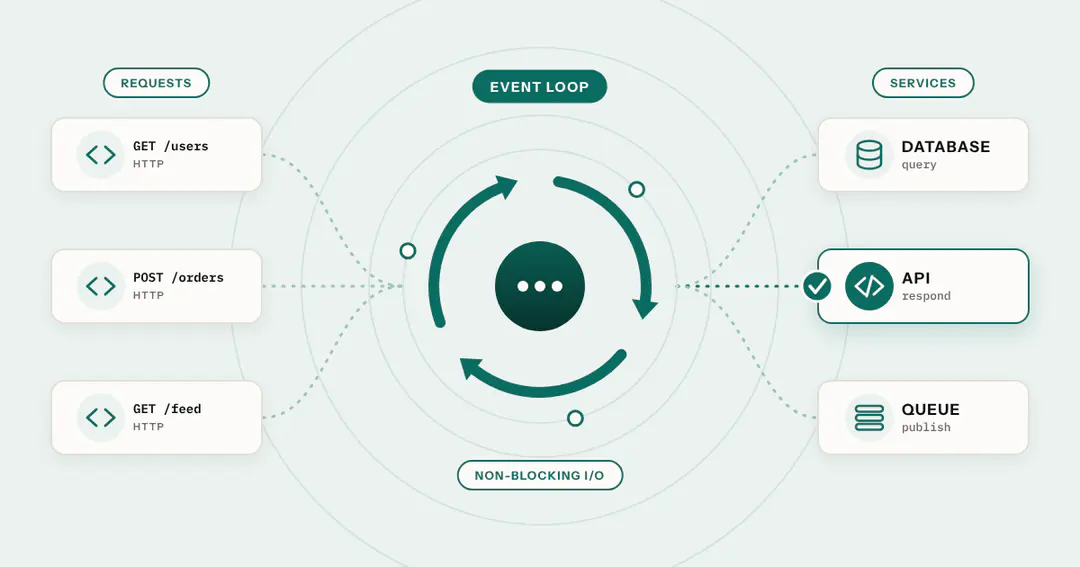
Node.js ranked first among web frameworks and technologies in Stack Overflow's 2026 Developer Survey, ahead of React and Next.js. For an engineering leader choosing between Node.js development companies, that popularity creates its own problem: almost every agency lists Node.js, so the listing tells you very little. Searches for nodejs development companies return dozens of near-identical lists, and few explain how the companies were chosen.
The runtime is also changing under your feet. From version 27, Node.js moves from two major releases a year to one, and every release becomes long-term support, according to the Node.js project's announcement. Node.js 27 entered its alpha phase in October 2026, ships in April 2027 and reaches LTS in October 2027. A vendor that cannot explain how it plans upgrades around that calendar is handing you a maintenance problem for 2028.
This list is built around the worries engineering leaders raise most: engineers who rotate off the project, teams that cannot explain their own architecture, and estimates that drift. We started from the Clutch Node.js directory and each company's own Node.js pages, kept only the companies whose details we could confirm in more than one place, and evaluated them against six criteria, set out below. We build Node.js backends ourselves, which is why the criteria focus on what an engineering leader can check before signing.
Procedure is one of the companies evaluated in this list. We applied the same criteria and data sources to every company, including ourselves, and the methodology is set out below.
How We Evaluated These Node.js Development Companies
We evaluated each company against six criteria, using only what it publishes on its own pages or its Clutch profile. Where a company does not publish something, we treat it as a gap and say so, for every company including Procedure. Companies are grouped by the buyer they suit best, and the groups are not ranked against each other. Within each group, the company that publishes more about staffing, delivery and cost is listed first.
| Criterion | What counts as evidence |
|---|---|
| Node.js engineering depth | Named Node.js builds, frameworks and architecture choices, published technical content |
| Engineer seniority and vetting | A stated seniority mix, who staffs the work, whether you approve the team |
| Team continuity and retention | A published retention figure or average engagement length |
| Delivery model and onboarding | Engagement models, time to first deployment or first team member |
| Client satisfaction | The Clutch overall rating |
| Cost clarity | A Clutch rate band, plus published cost ranges for typical projects |
Where the data comes from: Ratings, rate bands, team-size bands, HQ and founding years come from live Clutch profiles. Services, clients and engineering content come from each company's own website. Where a company does not publish a figure, the table says N/A.
Node.js Development Companies Compared at a Glance
| Group | Company | Best for | Clutch | Partnership length | Node.js tools named | Engagement models | Time to start |
|---|---|---|---|---|---|---|---|
| Long-term backend team | Procedure | Experienced Node.js engineers and architecture you can read after handoff | 4.8 | 3+ years on average, 98% retention | NestJS, Fastify, Express, Socket.IO, ws | Dedicated developer, backend pod, project-based | 5 days to first deployment |
| Long-term backend team | Binary Studio | Dedicated Node.js teams with sprint-by-sprint demos | 4.9 | Partnerships average 4+ years | Express, Fastify | Dedicated team | Team assembled within 2 weeks |
| Fast staff augmentation | Incora | Budget-conscious staff augmentation with a Node.js-heavy profile | 5.0 | N/A | Express, NestJS, Koa, Fastify, Hapi, Sails | Staff augmentation, project-based | Profiles within 48 hours |
| Fast staff augmentation | Digis | Larger Node.js talent pools on short notice | 4.9 | N/A | Express, Feathers, Hapi, Koa, LoopBack, Nest, Sails, Strapi | Staff augmentation, custom app development, API development | Candidate matching within 24 hours |
| Fast staff augmentation | The Software House | Scale-ups that want a Node.js-focused team in Poland | 4.8 | Most partners stay 2-3 years | Node.js, TypeScript, GraphQL, AWS | Self-managed product team, staff augmentation | N/A |
| Early-stage and full-service | Clockwise Software | SaaS and marketplace products with a product-minded team | 4.9 | N/A | Node.js, NestJS | Discovery-led projects, dedicated teams | N/A |
| Early-stage and full-service | Monterail | Product teams that want a long-established Poland-based partner | 4.8 | N/A | N/A | N/A | N/A |
| Runtime and security | Nearform | Core-level Node.js performance and security work | N/A | N/A | Node.js, Fastify | N/A | N/A |
The Best Node.js Development Companies for 2027
We have grouped the companies by the kind of buyer each suits best, and within each group list first the company that publishes more about staffing, delivery and cost. There is no single overall rank, because a runtime specialist and a staff augmentation firm answer different questions. Each company is a good fit for some buyers and not for others, and we say where.
Best Node.js Development Companies for a Long-Term Backend Team
These companies suit buyers who want an ongoing backend team and a clean handover.
Procedure
Best for: engineering leaders who want experienced Node.js engineers, a say in who joins the team, and architecture they can read after the engagement ends.
Founded: 2017 | HQ: Mumbai, India | Team: 50-249 | Rate: $50-99/hr
Procedure builds Node.js backends for product teams that need experienced engineers and an architecture they can run on their own. The work is organized around three questions every buyer should ask a vendor: who is on the team, how the build runs, and what you own at the end.
How the team is staffed
The client interviews and approves each team member. A dedicated developer has 4+ years across NestJS, Express or Fastify and covers API design, database optimization, DevOps and cloud work. A backend pod is 2 to 4 engineers plus a lead, and the lead is accountable for scope, quality and timelines. Average partnerships run 3+ years and client retention is 98%.
How a build runs
Most Node.js API projects reach production in 8 to 16 weeks, in five phases:
| Phase | Typical length | What happens |
|---|---|---|
| Architecture and discovery | 1-2 weeks | Requirements, traffic patterns and integration points. A technical proposal comes before any code |
| API design and data modeling | 1-2 weeks | OpenAPI or GraphQL contracts are written first, so the frontend can build against mocked endpoints |
| Development and iteration | 6-16 weeks | Working endpoints every two weeks, with automated tests written alongside features |
| Load testing and hardening | 1-2 weeks | Simulated production traffic. Nothing ships until it handles expected load with headroom |
| Handoff and support | Varies | Generated documentation, architecture decision records and runbooks |
The first deployment lands in 5 days from the start of the engagement.
What Procedure builds with, and why
The stack is NestJS, Fastify and Express, chosen by use case rather than habit, with Socket.IO and ws for real-time features. Strict TypeScript is on every project, and shared types between the API and a React frontend mean a contract change breaks the build instead of production. Observability is part of the first scaffold: structured logging, distributed tracing and health checks. Services are sized by team boundaries, deployment frequency and scaling needs, not split into microservices by default.
The work covers REST and GraphQL APIs with versioning, authentication, rate limiting and error handling from the start; microservice architectures with message queues or gRPC between services; real-time applications such as chat, live notifications and streaming dashboards; backend-for-frontend layers; cloud-native services on AWS Lambda, Docker and Kubernetes with SQS, EventBridge or Kafka; and legacy backend modernization from PHP, Ruby or aging Express codebases.
What you own at the end
Architecture is designed to be exit-ready. That means clean service boundaries, documented decisions, no proprietary dependencies and client ownership of everything built. Handoff includes architecture decision records and runbooks, so the next team, in-house or external, is not starting from a blank page.
Engagement models and cost
| Model | What it is | Minimum |
|---|---|---|
| Dedicated developer | One experienced engineer embedded in your team | 3 months |
| Backend pod | 2 to 4 engineers plus a delivery lead who own architecture through deployment | 6 months |
| Project-based | Fixed price with defined milestones, for work where API contracts are already settled | Scope-dependent |
Published ranges are $15,000 to $40,000 for an API backend with 10 to 20 endpoints for a mobile app, $50,000 to $150,000 for a microservices platform with 5 to 10 services, and $100,000 to $300,000 or more for enterprise backends with complex integrations, authentication and real-time features. A free architecture consultation scopes the work.
Quick facts:
- Clutch: 4.8
- Client retention: 98%, average partnership 3+ years
- Time to first deployment: 5 days
- Typical delivery: 8 to 16 weeks to production for most API projects
Why they stand out:
- Experienced engineers, and you approve each one
- Contract-first API design and a load testing phase before go-live
- ADRs and runbooks delivered at handoff, with no lock-in
- Published engagement models and cost ranges
Best suited for: product companies with an ongoing backend roadmap, and teams modernizing a legacy backend. See Procedure's Node.js development services.
Binary Studio
Best for: teams that want a dedicated Node.js team with a visible delivery rhythm.
Founded: 2005 | HQ: Lviv, Ukraine | Team: 50-249 | Rate: $50-99/hr
Binary Studio assembles a dedicated team within two weeks and shows a working version after each sprint. It states that a senior architect and a head of delivery oversee every project, and that partnerships average more than four years. Its Node.js page names Express and Fastify and lists three Node.js projects with their stacks, but gives no scope or results, and it does not say whether you can approve engineers before they join. A project manager reports on progress, and clients can speak to the team directly. The minimum project size is $25,000+.
Quick facts: Clutch 4.9 | Partnerships average 4+ years (self-reported) | Minimum project $25,000+
Best suited for: mid-size products that need a predictable delivery cadence.
Best Node.js Development Companies for Fast Staff Augmentation
These companies suit buyers who already have technical leadership and need Node.js engineers added quickly.
Incora
Best for: Node.js staff augmentation at a lower rate, with documented handoffs.
Founded: 2015 | HQ: Lviv, Ukraine | Team: 50-249 | Rate: $25-49/hr
Incora lists Express, NestJS, Koa, Fastify, Hapi and Sails, and its role descriptions are specific, covering OWASP-aware security, Kubernetes and Terraform, and NestJS with CQRS. Engineers have 5+ years of experience, profiles arrive within 48 hours, the client interviews and makes the final selection, and documentation and handoff are provided on every project. Staff augmentation starts from $5,000. It publishes no retention figure, so ask how many Node.js engineers are free for your start date.
Quick facts: Clutch 5.0 | Profiles within 48 hours | Staff augmentation from $5,000
Best suited for: budget-conscious teams that need Node.js engineers quickly.
Digis
Best for: teams that need a larger bench of Node.js developers on short notice.
Founded: 2015 | HQ: London, England | Team: 50-249 | Rate: $25-49/hr
Digis says it has 60+ Node.js developers available and matches candidates within 24 hours. Its page lists Express, Koa, NestJS and several other frameworks, names microservices and real-time processing as capabilities, and links three Node.js case studies. It says it works with the top 3.5% of backend specialists but does not describe the selection process, and it publishes no retention figure or approval step for the team. Its delivery process runs through a dedicated team and a delivery plan, with automated testing and code reviews on deliverables.
Quick facts: Clutch 4.9 | 60+ Node.js developers (company figure) | Candidate matching within 24 hours
Best suited for: teams that need several Node.js engineers quickly and will provide the technical leadership themselves.
The Software House
Best for: scale-ups that want a Node.js-focused team in Poland.
Founded: 2012 | HQ: Gliwice, Poland | Team: 50-249 (Clutch) | Rate: $50-99/hr
The Software House builds its Node.js service on TypeScript, GraphQL and AWS, with a focus on real-time work and mini-teams that build separate components at the same time. Most partners work with it for two to three years, and it runs two to four week sprints through a self-managed product team or staff augmentation. Its Clutch profile says it has worked with more than 160 scale-ups and SMBs over 12 years and shows a Premier Verified badge. The minimum project size is $25,000+. Its staffing is described as mid-senior, so ask for the seniority mix and how engineers are vetted.
Quick facts: Clutch 4.8 | Typical partnership 2-3 years | Minimum project $25,000+
Best suited for: funded product companies that want to extend a team with a nearshore Node.js group.
Best Node.js Development Companies for Early-Stage and Full-Service Builds
These companies suit buyers who want product and design support alongside engineering.
Clockwise Software
Best for: SaaS and marketplace products that need product judgment as well as backend skill.
Founded: 2014 | HQ: Edinburgh, Scotland | Team: 50-249 | Rate: $50-99/hr
Clockwise says it has delivered 200+ products, and Clutch reviews describe real Node.js work, including a marketplace built on Nest.js and React and a backup platform with integrations to GitHub, GitLab, Trello, Jira and Notion. It puts a discovery phase first, with fixed-price packages at $12,000, $16,000 and $25,000. Ask how changes to an estimate are handled. The minimum project size is $50,000+.
Quick facts: Clutch 4.9 | Discovery packages $12,000 to $25,000 | Minimum project $50,000+
Best suited for: early-stage SaaS and marketplace builders who want discovery before development starts.
Monterail
Best for: product teams that want a long-established partner with design and engineering together.
Founded: 2010 | HQ: Wroclaw, Poland | Team: 50-249 | Rate: $25-49/hr
Monterail cites 900+ projects, 130+ people and more than 16 years in business, and maintains 19 open-source npm packages, mostly frontend tooling. Its Node.js page names no frameworks, describes no architecture and shows no seniority mix or retention figure, so ask which engineers would staff a Node.js engagement.
Quick facts: Clutch 4.8 | 16+ years in business (company figure)
Best suited for: product-led companies that need a full team, not a Node.js specialist.
Best Node.js Development Companies for Runtime and Security Problems
This one suits a narrow, hard problem rather than general backend delivery.
Nearform
Best for: teams that need core-level Node.js expertise, such as performance, security and framework work.
Founded: 2011 | HQ: Tramore, Ireland | Team: 50-249 | Rate: $150-199/hr
Nearform says it has been instrumental to the development of Node.js since 2011, created the Fastify framework and has Fastify maintainers and Node.js contributors on staff. It also contributes security engineering to the OpenSSF Alpha-Omega project. That matters most for runtime-level problems: a performance ceiling, a supply chain concern or a Fastify-heavy codebase. The rate band is the highest here, the minimum project size is $50,000+, and Nearform has no Clutch rating yet, so ask for references.
Quick facts: Clutch N/A | Created Fastify | Minimum project $50,000+
Best suited for: organizations with a hard Node.js performance or security problem and a specialist budget.
What Node.js Development Services Should Actually Cost in 2027
The Clutch rate bands for the eight companies in this list run from $25-49 an hour to $150-199. Four sit at $50-99, three at $25-49 and one at $150-199. That is a small sample and not a market average, but it shows the spread a buyer will see.
| Company | Clutch rate band | Minimum project size |
|---|---|---|
| Procedure | $50-99/hr | $10,000+ |
| Binary Studio | $50-99/hr | $25,000+ |
| The Software House | $50-99/hr | $25,000+ |
| Clockwise Software | $50-99/hr | $50,000+ |
| Incora | $25-49/hr | Staff augmentation from $5,000 |
| Digis | $25-49/hr | N/A |
| Monterail | $25-49/hr | N/A |
| Nearform | $150-199/hr | $50,000+ |
The hourly band tells you less than the minimum project size and what the quote includes. A $10,000 minimum and a $50,000 minimum suit different buyers, so decide your budget first and use it to filter.
For project-level numbers, ask for ranges by project type. Procedure publishes three: $15k to $40k for an API backend for a mobile app, $50k to $150k for a microservices platform, and $100k to $300k+ for enterprise systems. Treat any quote far below the range for your project type as a question, not a bargain.
Four things move Node.js cost more than the hourly rate:
- Scope clarity. A discovery phase costs money and reduces change orders later. Clockwise lists its discovery packages at $12,000 to $25,000.
- Seniority mix. Senior engineers cost more per hour and often finish architecture work in fewer hours.
- Real-time and scale requirements. WebSockets, load testing and observability add work that cheaper quotes leave out.
- Handoff. Documentation and runbooks are an upfront cost that saves a larger one when the team changes.
The cheapest option is rarely the most cost-effective. If a quote leaves out testing, observability or documentation, you will pay for them later, usually at a worse moment.
5 Red Flags Your Node.js Development Partner Will Fail You
1. They cannot say who will be on your team. If the answer is "we will assign people after signing", expect rotation. Ask for named engineers, their years of experience and whether you can interview them before work starts.
2. They cannot show an architecture decision. A team that understands its own system can show you why it chose one queue, framework or data store over another. Ask for a sample architecture decision record from a past project, with the client details removed. See our guide on building a Node.js backend with an external team.
3. TypeScript and testing are optional. In a Node.js codebase, the absence of strict types and an agreed test standard is where defects hide. Ask what the default is on a new project and who enforces it, and whether a failing test or an unhandled error stops a release.
4. Nobody mentions load testing, the event loop or monitoring. A service that works with ten users and fails with ten thousand is a launch-week problem, and in Node.js the usual cause is one synchronous operation blocking the event loop. Ask how they keep CPU-heavy work such as PDF generation or large JSON parsing off request handlers, how they size database connection pools once the service runs on several processes, and whether the service shuts down gracefully so in-flight requests are not dropped. Ask when load testing happens and what is monitored from day one. Our write-up on scaling Node.js in production covers what good answers look like.
5. There is no upgrade or handoff plan. Node.js is moving to one major release a year, with every release becoming LTS. Ask how the team plans runtime upgrades, and what you receive at handoff: runbooks, decision records and a working local setup.
How To Choose Between Node.js Development Companies
Seven questions to ask before you sign. Each one tests a criterion from our methodology.
- What have you built in Node.js, and what did you choose and why? (Engineering depth.) Look for named frameworks and specific trade-offs, not a list of logos. Our notes on NestJS architecture patterns for enterprise APIs show what a specific answer sounds like.
- Who exactly will work on this, and can I approve them? (Seniority and vetting.) A stated experience bar for each engineer and client approval of the team are the strongest answers.
- How long do your clients usually stay? (Continuity.) A figure beats an adjective. Two to three years is a reasonable bar.
- How quickly will a first engineer or first deployment arrive? (Delivery and onboarding.) Ask for the time to first deployment, not just the time to a signed contract.
- What do your clients say, and can I speak to one? (Client satisfaction.) Check the Clutch rating, then ask for a reference with a similar stack and size.
- What does a project like mine cost, and what is not included? (Cost clarity.) Ask for a range by project type and a written list of exclusions.
- What do I receive when the engagement ends? (Handoff.) Decision records, runbooks and a documented upgrade path.
If you want a second opinion on a shortlist, book a free architecture consultation with Procedure.
Frequently Asked Questions About Node.js Development Companies
Who are the best Node.js development companies?
It depends on what you need. For a long-term backend team with a documented handoff, Procedure and Binary Studio. For fast staff augmentation, Incora, Digis and The Software House. For early-stage builds, Clockwise Software and Monterail. For Node.js consulting on runtime and security problems, Nearform.
What does a Node.js development company do?
It designs, builds and maintains server-side applications on the Node.js runtime: APIs, microservices, real-time systems and integrations. The better ones also take on architecture decisions, testing, monitoring and upgrades, and hand over documentation so your team can run the system.
How much does Node.js development cost?
Among the companies in this list, Clutch rate bands run from $25-49 an hour to $150-199, with most between $25 and $99. Minimum projects range from about $5,000 for staff augmentation to $50,000+. Procedure publishes project ranges from $15k to $40k for a mobile-app API up to $100k to $300k+ for enterprise systems.
How do I choose between Node.js development companies?
Assess vendors on engineering depth, who staffs the work, retention, onboarding, client ratings and cost clarity. Ask for named frameworks, an architecture decision record, a retention figure and a time to first deployment. Anything a vendor will not put in writing should count against it.
Is Node.js still a good choice in 2027?
Yes. It ranked first among web frameworks and technologies in Stack Overflow's 2026 Developer Survey, ahead of React and Next.js. It suits APIs, real-time features and integration layers, and it lets one language run across frontend and backend.
What is changing in Node.js releases?
From Node.js 27, there is one major release a year in April, promoted to LTS in October, and every release becomes LTS. Node.js 27 entered alpha in October 2026, ships in April 2027 and reaches LTS in October 2027. Node.js 26 enters LTS in October 2026.
Should I use a dedicated developer or a team?
A dedicated developer suits a roadmap one person can own and a team that can direct the work. A backend pod of two to four engineers with a lead suits a larger service that needs architecture ownership. Procedure's minimums are three months for the first and six months for the second.
How fast can a Node.js team start?
It depends on the vendor, so ask for the time to first deployment rather than the time to a signed contract. Procedure publishes 5 days to first deployment. Many companies publish no figure at all.
What should I receive at the end of a Node.js project?
At minimum: architecture decision records, runbooks, a documented local setup, test coverage you can run, and monitoring dashboards. Agree the list before work starts, so handoff is a deliverable and not a favor.

Procedure Team
Engineering Team
Expert engineers building production AI systems.