
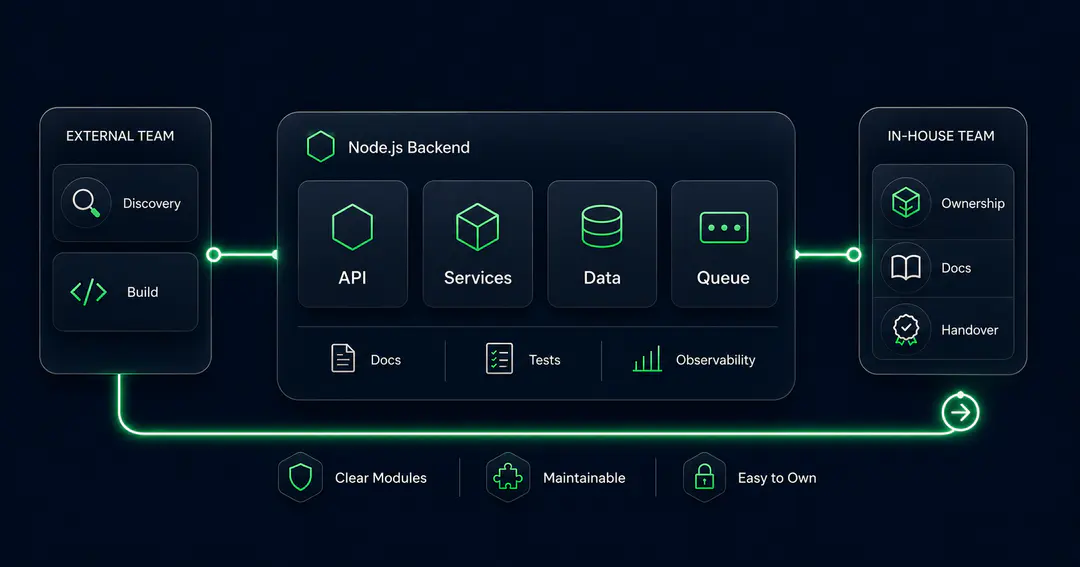
Most of the anxiety around handing a backend to an outside team is aimed at the wrong question. The worry is usually whether they can actually write good Node.js, and that one mostly sorts itself out in the first few weeks. The question that decides whether the engagement was a good idea shows up much later: in eighteen months, when the external team has rolled off or changed, can your own engineers pick this codebase up and keep shipping without a rewrite? That is the bar this piece is about.
Node.js is the most widely used web technology in the 2025 Stack Overflow Developer Survey, reported by 48.7% of respondents, so the supply of teams who can write it is deep. That depth is the problem as much as the comfort. Node.js is fast to start with, forgiving of loose structure, and happy to let a small team move quickly, which is exactly why an external team can show impressive velocity in month one and leave you with something brittle by month six. If you are still deciding whether the runtime itself is the right call, the Node.js vs Python comparison is the better starting point. This assumes the stack is settled and you are choosing how to build it with people who are not on your payroll.
What a Good Node.js Development Engagement Looks Like in Month One
A strong external team spends the first weeks doing things that do not look like progress to an impatient stakeholder. They ask about your existing systems, your deployment story, who owns what, and what "done" means to you. They write down the architecture decisions they are making and why, so those choices are not locked inside one contractor's head. And they get a thin slice running end to end in your CI early, a real request path through to a real response, instead of a month of local work that integrates in a big and painful bang later.
The teams that should worry you are the ones that start typing production code on day one. Fast keystrokes feel reassuring, but code written before anyone understands your constraints is code you will pay to unwind. You want to see discovery, a written plan, and a running skeleton before you see a feature list burning down. If the first standup is all green tickets and no questions, that is not speed, that is a team building the wrong thing quickly.
Ownership should be explicit from the start too. Whose GitHub organisation holds the repo, who can merge, who is on call when it breaks. Sort this in week one rather than at handover, because the alternative is discovering at the end that access and knowledge both live somewhere you cannot reach.
The Node.js Architecture an External Team Should Insist On
You do not need to dictate a framework, and you should be wary of anyone who treats a framework as a religion. What you should insist on is structure that a stranger can navigate. Clear module boundaries, so a change to billing does not ripple through auth. A sensible, conventional layout instead of a custom one that only the original author understands. Node.js itself is the default choice; the frameworks around it are not. NestJS sits at 6.7% usage in the same Stack Overflow survey, so an opinionated structure is a deliberate call the team should be able to defend, and the patterns in our NestJS architecture write-up hold up for the same reason: the convention is the documentation.
Observability belongs in from the beginning. Structured logs, basic metrics, and traceable request paths are cheap to add early and expensive to retrofit once an incident is already running. The same discipline applies to how the service behaves under load. A backend that works in a demo and falls over at real traffic is a common and avoidable outcome, and the production scaling patterns we have written about are the sort of thinking a good team brings unprompted, before the first outage.
The anti-pattern to watch for is cleverness. Node.js gives talented engineers a lot of rope, and the temptation to show off with elaborate abstractions is real. Clever code that only its author understands is a liability dressed as craftsmanship. Insist on boring, readable solutions. Boring is what your team can maintain.
What Happens When the Team Leaves? The Maintainability Test for Outsourced Node.js Backends

Here is the single test that separates a good engagement from an expensive one. Imagine the external team is gone tomorrow, no handover call, no Slack access. Could your engineers open the repo cold and understand it? If the honest answer is no, the work is not finished no matter what the ticket board says.
That test has concrete parts. There is documentation that explains the reasoning behind each decision, because the reasoning is the part that is impossible to reconstruct later. There are tests that actually cover the important paths, so your team can change things without fear. And there is no single person who is the only one who understands a critical piece, the bus factor of one that turns an external team into a permanent dependency. When maintainability is treated as a first-class deliverable, the handover is a formality. When it is not, the handover is where the project's full cost finally appears.
Red Flags When You Hire a Node.js Development Team
The signals that predict a weak Node.js development team show up early, well before the engagement ends. Four are worth watching for.
- Velocity theatre. Lots of merged pull requests and a moving burndown, with no tests and no documentation underneath. Speed without a safety net is debt you have not been billed for yet.
- "We will document it later." In practice this means never.
- Resistance to your engineers in the repository. A team confident in its work welcomes your people reading along and reviewing pull requests. A team that wants the codebase to itself is protecting something, usually its own indispensability.
- A stack chosen for the vendor's convenience. If the justification for a technology choice is that the team already knows it, and not that it suits your problem, you are buying their comfort at the cost of your maintenance.
The tradeoffs between runtimes are worth understanding on their own terms, which is worth checking against how we work with Node.js before you accept a lazy default.
How to Evaluate a Node.js Development Company Before You Commit
Most of these problems are avoidable if you ask the right things before signing. Ask to see real production code they have written, ideally from a system still in service. Ask how they handle incidents, because the answer tells you whether they have operated software or only built it. Ask, specifically, what handover looks like at the end of the engagement, and listen for whether they have a worked-out process or an improvised one.
The engagement model matters as much as the team. The two common shapes split along one line:
| Development company | Staff augmentation |
|---|---|
| Owns the architecture and the outcome | You own the architecture, they add capacity |
| Suits teams without in-house bandwidth to direct the work | Suits teams with technical direction but too few hands |
| Handover is the risk point | Knowledge drain on roll-off is the risk point |
The questions that separate an engineering partner from a body shop are the ones about what happens when things go wrong and what happens when they leave. A partner has thought about both. A body shop has thought about neither, because its model assumes you will keep paying for the knowledge it holds. If your search covers the frontend as well, what to look for when hiring a React development team applies the same discipline on that side.
What you are buying is a backend plus the ability to own it afterwards, and the second half is the part worth checking closely.
Node.js Backend Development With an External Team: The Short Version
Judge an external Node.js team on what your engineers can do with the codebase after it leaves. Look for discovery before code, structure a stranger can read, tests and documentation treated as deliverables, and a team that welcomes your engineers into the repo. Avoid velocity theatre, cleverness for its own sake, and anyone whose model depends on staying indispensable.
This is how we approach backend engagements, with the handover written into the plan from the start. You can see how we work on backend development, or follow our engineering work on LinkedIn.
Frequently Asked Questions
Should I hire a Node.js development company or use staff augmentation?
It depends on who owns the architecture. A development company takes end-to-end responsibility for delivering a working backend, which fits teams that need an outcome and do not have the in-house bandwidth to direct the work day to day. Staff augmentation places engineers inside your team and under your technical direction, which fits teams that have the architectural ownership but need more hands. The failure mode in both is the same: knowledge that never transfers back to you. Whichever model you pick, make maintainability and handover explicit in the engagement.
How do I evaluate a Node.js development team before hiring?
Ask to see real production code instead of a portfolio piece, ask how they handle incidents, and ask what handover looks like at the end. A team that has operated software in production answers all three fluently. Then give them a live problem from your own systems and watch whether they reason about your constraints or reach for a familiar default.
What are the red flags when outsourcing Node.js development?
Velocity theatre (merged pull requests with no tests or documentation underneath), "we will document it later," unwillingness to let your engineers into the repository, and a stack chosen for the vendor's convenience instead of your fit. Each one is visible well before the engagement ends.
Is Node.js a good choice for an outsourced backend?
For a large class of API and real-time workloads, yes, and its large talent pool makes an external team easy to staff. The caveat is that Node.js is forgiving of loose structure, so the discipline of an external team matters more here than on a stricter stack. Whether Node.js beats an alternative like Python for your specific workload is a separate question worth answering on its own terms.
Procedure Team
Engineering Team
Expert engineers building production AI systems.