
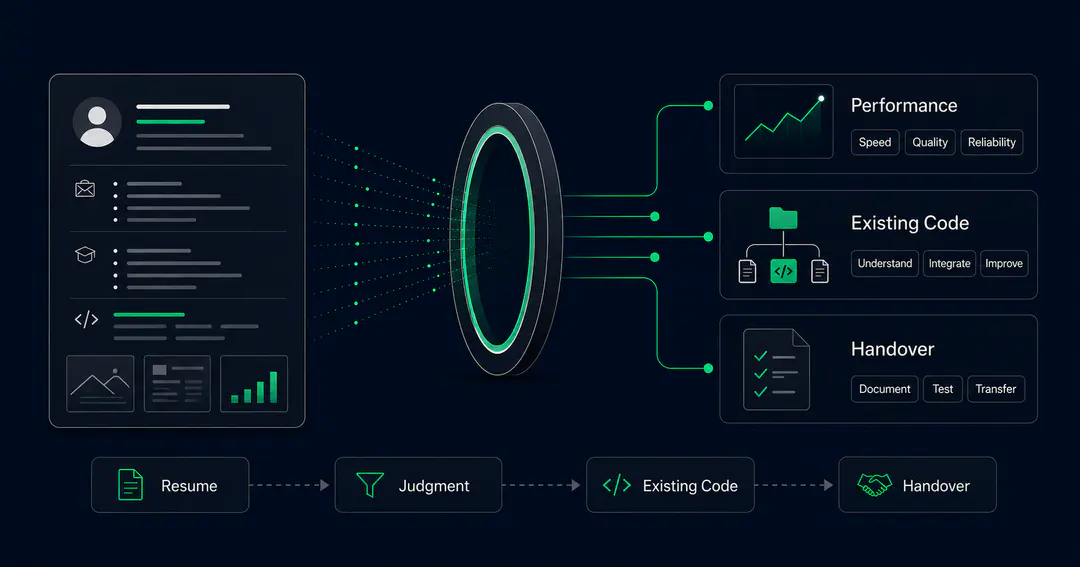
A portfolio proves that a team can build a React application under ideal conditions: a clean brief, a greenfield repo, and no legacy to trip over. That is useful to know, and it is also the easy part. What a resume cannot tell you is what happens when the app meets your users, your data volumes, and the codebase you already have. That gap between "can build a React app" and "can build the React app you actually need, in the situation you are actually in" is where most hiring decisions go right or wrong, and it is what this piece is about.
React is reported by 44.7% of respondents in the 2025 Stack Overflow Developer Survey, second only to Node.js, so the supply of teams who can assemble components and ship a demo is deep. The harder thing to assess, and the thing that matters more, is judgment: knowing which patterns hold up at scale, when to reach for a tool and when not to, and how to work inside constraints instead of around them. If you are earlier in the process and still weighing React against other frontend choices, the React technology overview is the place to start. This assumes React is decided and you are choosing who builds it.
What a Strong React Development Team Does That a Resume Won't Show
The first thing to look for is restraint. A weaker team reaches for a state management library on day one because that is the habit, adds a data-fetching abstraction on top, and wraps everything in context until a simple screen touches six providers. A stronger team asks what the app actually needs first, and often the answer is far less machinery than the resume-driven default. Over-engineering is not a sign of sophistication. It is a sign that nobody stopped to ask the question. The structural decisions that earn their keep are the ones we set out in our scalable frontend architecture guide, and a strong team arrives with opinions on them.
The second thing is performance discipline, and this is where portfolios are quietest. Anyone can make a small React app feel fast. Keeping it fast as the component tree grows, the data sets get real, and re-renders start cascading is a different skill, and it is one you cannot see in a screenshot. The patterns that separate teams here are concrete and worth probing for, the kind we have written up in our React performance in production piece. A team that can talk fluently about why a component re-renders, and what they do about it, has shipped React at scale. A team that cannot has shipped demos.
Can They Work in Your Code? The Test Most React Portfolios Skip
Here is the test that filters hardest. Most portfolios are greenfield. Your reality, more often than not, is a codebase that already exists, with its own history, its own compromises, and its own half-finished migration. Building fresh is straightforward. Working productively inside someone else's code, respecting what is there, improving it incrementally, and not proposing a rewrite in week one, is the mark of a team that has actually operated in the real world.
This matters most when the work is a migration rather than a build, and migrations are where inexperienced teams do the most damage. The instinct to tear it all down and start over is common and almost always wrong for a running product. A team worth hiring has a framework for doing this incrementally, the kind of decision-making we laid out in the legacy frontend migration guide. When you interview, give them a live screen from your actual codebase and skip the toy exercise. How they reason about existing constraints tells you more than any take-home ever will.
Beyond the Code: How a React Team Works With Yours
The code is half of it. The other half is whether the team makes your own engineers better or sidelines them. Look at how they handle code review. A strong team welcomes your developers reading and reviewing their pull requests, because they are confident in the work and they know shared understanding is the point. A team that wants the frontend to itself, that treats your engineers as an interruption, is protecting its own position instead of serving your product.
Handover deserves the same scrutiny. Ask, before you sign anything, what the end of the engagement looks like. A team that has thought about handover has a real answer: documentation, knowledge transfer sessions, and a codebase your people can own. A team that improvises the answer in the room is telling you that its model depends on staying in the room, which is a fine outcome for them and an expensive one for you. The same ownership question decides a backend engagement with an external team, if you are evaluating both halves of the stack at once.
Red Flags When You Hire React Developers
A few signals reliably predict trouble when you hire React developers. Four are worth watching for.
- The rewrite reflex. A team that proposes rebuilding your working frontend from scratch before understanding why it is the way it is.
- Tooling maximalism. Every problem answered with another dependency, until the bundle is heavy and nobody can explain half of what is in it.
- No performance strategy. Anything beyond "we will look at performance later" is missing, and later is usually after your users have already felt the lag.
- Resistance to your engineers in the repository. This almost always signals a team protecting its own position over the outcome.
None of these show up on a resume. All of them show up in a good technical conversation, which is exactly why the conversation matters more than the paperwork.
Questions to Ask Before You Hire a React Development Company

A short list separates an engineering partner from a staffing line item. Ask them to walk you through a React app they took to real scale, and what broke on the way. Ask how they decide whether a piece of state belongs local, lifted, or global, because the answer reveals whether they have judgment or just habits. Ask what they would do with the most awkward part of your existing frontend, and listen for whether they respect the constraints or reach for the demolition ball. Ask what handover looks like. The teams worth hiring answer these fluently because they have lived them. The teams to avoid give you the brochure.
You are not hiring people to write React. Plenty of people write React. You are hiring judgment about how to write it for your product, and the willingness to leave you able to carry it forward. That is what to look for beyond the resume.
Hiring a React Development Team: The Short Version
Hiring a React development team well comes down to judgment rather than credentials: restraint over machinery, performance discipline you can probe in conversation, comfort inside a codebase that already exists, and a review and handover culture that leaves your engineers stronger. Weight the technical conversation over the portfolio, and put any team you are considering in front of your own code before you decide.
This is how we approach frontend engagements, as a partner your team ends up abler for working with. You can see how we work on frontend development, or follow our engineering work on LinkedIn.
Frequently Asked Questions
Should I hire a React development company or individual React developers?
The deciding factor is who sets the technical direction. A development company takes responsibility for delivering a working frontend and brings its own judgment about structure and patterns, which works when what you need is an outcome. Hiring individual developers, or using staff augmentation, places engineers under your direction and works when you already own the architecture. In both cases, the thing to protect is that judgment and knowledge transfer back to you instead of leaving with the vendor.
How do I evaluate a React development team before hiring?
Go beyond the portfolio. Ask them to walk through a React app they took to real scale and what broke on the way, ask how they decide where a piece of state lives, and hand them a real problem from your codebase rather than a take-home. How they reason about your existing constraints tells you more than any polished sample.
What are the red flags when hiring React developers?
The rewrite reflex (proposing to rebuild your working frontend before understanding it), tooling maximalism (a new dependency for every problem), no performance strategy beyond looking at it later, and resistance to your engineers reviewing their code. None show up on a resume; all show up in a technical conversation.
Does it matter whether a React team has worked in existing codebases, not just greenfield?
It matters a great deal. Most portfolios are greenfield, but most real work is inside a codebase that already exists. A team that can improve existing code incrementally, respect what is there, and avoid a week-one rewrite is far more valuable than one that only shines on a blank slate. Test for it directly with a real problem from your own repo.
Procedure Team
Engineering Team
Expert engineers building production AI systems.