




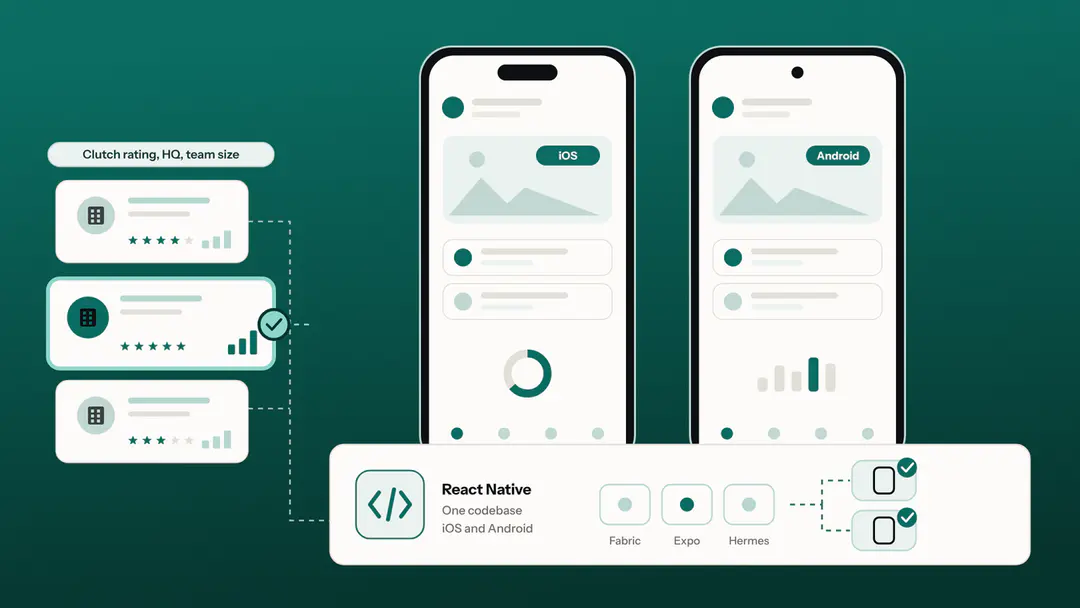
Summary: We compared ten React Native app development companies across the US, Canada, Poland and India, Procedure included. This guide covers what each does best, what the work costs, and which questions to ask before you sign. Since React Native 0.82, the New Architecture is the only architecture, so a vendor's experience with upgrades matters more than it used to.
React Native has run entirely on the New Architecture since version 0.82, and version 0.84 made Hermes V1 the default JavaScript engine on iOS and Android. The latest release, 0.88, shipped on 19 October 2026 with no user-facing breaking changes, and the State of React Native 2025 survey reports 80% adoption of the New Architecture. A team that learned React Native before the New Architecture now has to show it can audit native modules, handle upgrades, and ship releases under the current rules.
This guide to the top React Native app development companies is for engineering leaders choosing a delivery partner. We scored ten companies against eight weighted criteria, and the sections after the profiles cover cost, red flags, and how to choose.
Procedure is one of the companies evaluated in this list. We applied the same criteria and data sources to every company, including ourselves, and the methodology is set out below.
How We Evaluated These React Native Development Companies
We scored each company on eight criteria. React Native engineering depth carries the most weight, because recent releases have changed what a vendor needs to know.
| Criterion | Weight | What we looked at |
|---|---|---|
| React Native engineering depth | 25% | Whether React Native is a named, described service; published engineering work; contributions to the ecosystem |
| Published production evidence | 15% | Named clients, case studies, open-source work and conference or content output |
| Client satisfaction | 15% | The company's rating on Clutch |
| Delivery model clarity | 15% | Published engagement models, team size, rate band, HQ and founding year |
| Full-product coverage | 10% | Whether the same team handles web, backend, cloud or design around the app |
| Team continuity | 10% | Client retention and partnership length, where the company publishes them |
| Onboarding speed | 5% | Time to first deployment, where the company publishes it |
| Transparency | 5% | Whether public facts agree across Clutch and the company's own site |
Where the data comes from. Ratings, rate bands, team-size bands, HQ and founding years come from live Clutch profiles. Services, clients and engineering content come from each company's own website. Release facts come from the React Native release notes. Where a company does not publish a figure, the table says N/A, and we did not estimate it.
React Native App Development Companies Compared at a Glance
| Company | Best for | Clutch | Team size | HQ | Engagement models | Published React Native work | Time to start |
|---|---|---|---|---|---|---|---|
| Designli | Funded startups and mid-market products | 5.0 | 50-249 | Greenville, SC | Dedicated product team, MVP program | N/A | N/A |
| Procedure | Web, backend and mobile from one team | 4.8 | 50-249 | Mumbai, India | Dedicated developer, mobile pod, project-based | Published work: New Architecture, offline-first data | 5 days |
| Callstack | Performance, migrations, brownfield | 4.8 | 50-249 | Wroclaw, Poland | Consulting, product development, training | Open source, articles, podcast | N/A |
| GeekyAnts | Large-scale, multi-framework delivery | 4.9 | 250-999 | Bengaluru, India | Dedicated and project teams | Open-source UI libraries | N/A |
| Apzumi | Healthcare and wellness apps | 4.9 | 50-249 | Poznan, Poland | Team augmentation, dedicated team | Healthcare case studies | N/A |
| Software Mansion | React Native with web, AI and real-time work | 4.8 | 250-999 | Krakow, Poland | N/A | Open-source libraries, case studies | N/A |
| MindSea | Health research and clinical apps | 5.0 | 10-49 | Halifax, Canada | Blueprint, then build | Health and research case studies | N/A |
| AgileEngine | Enterprise-scale engineering | 5.0 | 1,000-9,999 | Boca Raton, FL | Dedicated teams, managed delivery | N/A | N/A |
| Infinite Red | US-based, fully remote team | 4.8 | 10-49 | Vancouver, WA | Fully remote US team | Open source, podcast, newsletter | N/A |
| TekRevol | Budget-conscious builds and extra capacity | 4.8 | 250-999 | Houston, TX | Staff augmentation, custom development | N/A | N/A |
The 10 Best React Native App Development Companies
1. Designli
Best for: Funded startups and mid-market companies building a first or next product.
Founded: 2013 | HQ: Greenville, SC | Team: 50-249 | Rate: $50-99
Designli is a product studio that builds iOS and Android apps in React Native, alongside SaaS platforms, internal tools, UX design and AI implementation. Each client gets a dedicated product team with biweekly demos. Its terms include MVP and rescue programs, a fully refundable first 14 days and cancellation on 30 days' notice.
Quick facts:
- Clutch: 5.0
- Engagement: dedicated product team, MVP and rescue programs
- Terms: 14-day refund window, 30-day cancellation notice
Why they stand out:
- Published commercial terms
- Product and design in the same team
- US time zones
Best suited for: Startups that want a defined first-product engagement with clear exit terms.
2. Procedure
Best for: Product teams that want React Native delivered alongside web, backend, and cloud by one team.
Founded: 2017 | HQ: Mumbai, India | Team: 50-249 | Rate: $50-99
Procedure is a full-stack engineering studio, so the app, the web product, and the API behind them are built by the same team. The React Native practice covers cross-platform apps, taking an existing React web product to mobile, MVPs, enterprise apps, performance optimization, and migration from native. Its listed stack is React Native with the New Architecture (Fabric and TurboModules), Hermes, Expo in managed and bare workflows, TypeScript, Storybook, and Sentry.
Engagements come in three shapes. A dedicated developer has a three-month minimum, a mobile pod of two to four engineers (frontend, backend, and QA) has a six-month minimum, and project delivery is milestone-based. Procedure reports that new engineers reach a first deployment in 5 days, a client retention rate of 98%, and an average partnership of more than three years. Engineers are vetted by the founders, and Procedure says it turns down far more candidates than it takes on. Each pod includes a delivery lead who owns scope and timelines.
Procedure has hands-on experience with the topics engineering leaders tend to search for, including what changes after migrating to the New Architecture and offline-first data design with WatermelonDB, RxDB, and PowerSync.
Quick facts:
- Clutch: 4.8
- Engagement models: dedicated developer, mobile pod, project-based
- Stack: React Native, Expo, TypeScript, Hermes, Sentry
- Retention and partnership length: company-reported
- Time to first deployment: 5 days
Why they stand out:
- Web, backend and mobile handled by the same engineers
- A pod structure that includes backend and QA
- Hands-on work on the New Architecture and offline-first data
Best suited for: Product companies taking a React web product to mobile, or building an MVP and the API behind it together.
Explore Procedure's React Native development services
3. Callstack
Best for: Teams with performance, migration, or brownfield requirements.
Founded: 2016 | HQ: Wroclaw, Poland | Team: 50-249 | Rate: Not published
Callstack is a React Native consultancy. Its site lists performance optimization, brownfield integration, upgrades and migrations, release automation and monitoring, and team training as services, alongside product development. It publishes articles, a podcast and a newsletter, and maintains open-source projects.
Quick facts:
- Clutch: 4.8
- Services: React Native and React development, migrations, performance, release automation, training
- Engagement: consulting, product development, training
Why they stand out:
- Focus on React Native and React
- Upgrades and brownfield integration listed as services
- Published articles, podcasts, and newsletters
Best suited for: Companies with an existing app that needs performance work, an architecture migration or a brownfield integration.
4. GeekyAnts
Best for: Large-scale delivery across several frameworks.
Founded: 2006 | HQ: Bengaluru, India | Team: 250-999 | Rate: $25-49
GeekyAnts is a product engineering company. Its site lists mobile engineering across React Native, Flutter, and native, along with AI and web work. It maintains open-source UI libraries, and its case studies span banking, healthcare, real estate, and commerce.
Quick facts:
- Clutch: 4.9
- Services: mobile (React Native, Flutter, native), AI, web
- Engagement: dedicated and project teams
Why they stand out:
- Large team in a single company
- Open-source UI tooling
- Rate band of $25-49
Best suited for: Companies that need to scale a mobile team quickly or that build across React Native and other frameworks.
5. Apzumi
Best for: Healthcare, fitness and wellness apps.
Founded: 2013 | HQ: Poznan, Poland | Team: 50-249 | Rate: $50-99
Apzumi builds mobile and web software for healthcare, fitness and wellness, and lists React Native in its hybrid mobile stack. Its case studies cover diagnostic imaging documentation, a medical device app and a health assessment platform. It offers team augmentation and dedicated teams, plus product discovery, proof-of-concept and MVP work, and ongoing support.
Quick facts:
- Clutch: 4.9
- Focus: healthcare, fitness and wellness
- Engagement: team augmentation, dedicated team, MVP delivery
Why they stand out:
- Healthcare and wellness focus
- Discovery through support in one engagement
- Team augmentation and dedicated team models
Best suited for: Health and wellness companies where regulation and data handling shape the build.
6. Software Mansion
Best for: Products that combine React Native with web, AI, or real-time work.
Founded: 2012 | HQ: Krakow, Poland | Team: 250-999 | Rate: $100-149
Software Mansion is a custom software company for mobile, web, and AI, and its site lists React Native as a core service. It also covers web development, Elixir, multimedia, real-time communication, and platform engineering. Its case studies span consumer, health, and messaging products.
Quick facts:
- Clutch: 4.8
- Services: React Native, web, Elixir, AI, platform engineering
- Engagement: custom software projects
Why they stand out:
- Mobile, web, and AI under one company
- Open-source releases
- Case studies across several product types
Best suited for: Products that combine mobile with real-time features, custom libraries or web and AI work.
7. MindSea
Best for: Health research, clinical and public-health apps.
Founded: 2007 | HQ: Halifax, Canada | Team: 10-49 | Rate: $150-199
MindSea is a studio that has built apps since 2007, and lists React Native app development as a service. Its work centers on healthcare providers, health-tech startups, university and hospital research teams, and public-health organizations. Its process runs from a Blueprint phase through UX design and a clickable prototype to development and data-privacy compliance, with support after launch.
Quick facts:
- Clutch: 5.0
- Process: Blueprint, UX and prototype, build, compliance
- Clients include universities and hospitals, and research groups
Why they stand out:
- Design and compliance in one process
- Health and research focus
- Support after launch
Best suited for: Research teams and health organizations building a patient-facing app.
8. AgileEngine
Best for: Enterprise-scale engineering across mobile, web, data, and AI.
Founded: 2010 | HQ: Boca Raton, FL | Team: 1,000-9,999 | Rate: $25-49
AgileEngine is a custom software company. Its site presents web UI, backend, cloud, DevOps, and mobile services, and its case studies lean toward AI-enabled products. Engagement options include remote engineering teams working to the client's backlog and fully managed cross-functional delivery.
Quick facts:
- Clutch: 5.0
- Services: custom software across web, backend, cloud, DevOps, and mobile
- Models: dedicated teams and managed delivery
Why they stand out:
- Scale under one contract
- Mobile, backend and AI from the same firm
- Staffing models
Best suited for: Larger organizations that need mobile as part of a broader engineering program.
9. Infinite Red
Best for: US-based engineers on long-running product work.
Founded: 2005 | HQ: Vancouver, WA | Team: 10-49 | Rate: $200-300
Infinite Red is a small, US-based consultancy that works in React Native. Its site lists React Native for mobile, web, and desktop, Expo, native iOS and Android, and agentic coding. The company maintains open-source projects and publishes a podcast and a newsletter. It lists the highest rate band in this comparison.
Quick facts:
- Clutch: 4.8
- Services: React Native, Expo, native iOS and Android
- Team: fully remote, US-based
Why they stand out:
- US-based, fully remote team
- Covers web and desktop as well as mobile
- Open source and media
Best suited for: Funded product teams that want a small US-based team and can budget at a premium rate.
10. TekRevol
Best for: Budget-conscious builds and added delivery capacity.
Founded: N/A | HQ: Houston, TX | Team: 250-999 | Rate: $25-49
TekRevol is a software development company. Its site lists React Native app development among its services and shows case studies in fitness, field operations, and manufacturing. It sells IT staff augmentation, custom software, and digital product engineering. The founding year differs between its site and its Clutch profile, so we leave it blank.
Quick facts:
- Clutch: 4.8
- Services: React Native, staff augmentation, custom software
- Models: staff augmentation, custom development
Why they stand out:
- Rate band of $25-49
- Industry range from logistics to fintech
- Capacity options
Best suited for: Teams that need extra mobile capacity and have strong internal technical direction.
What React Native App Development Costs by Region and Engagement Type
React Native rates move with location, seniority, and team shape more than with the framework. Accelerance's 2026 Global Software Development Rates & Trends Guide, based on a survey of 60 software development partners, gives these hourly ranges for outsourced development:
| Region | Junior | Senior |
|---|---|---|
| Asia | $24-31 | $31-41 |
| Europe | $31-39 | $64-76 |
| Latin America | $33-45 | $60-75 |
The guide reports rates edging down over the past year: nearly 8% in Asia, 4.4% in Europe and 7.1% in Latin America. It covers general software development and gives no US figure, so treat it as a regional benchmark and not a React Native price list.
The companies in this list publish their own hourly bands on Clutch:
| Region | Companies in this list | Clutch rate band |
|---|---|---|
| United States | Designli, AgileEngine, Infinite Red, TekRevol | $25-49 to $200-300 |
| Canada | MindSea | $150-199 |
| Poland | Callstack, Apzumi, Software Mansion | $50-99 to $100-149 (Callstack does not publish a rate) |
| India | Procedure, GeekyAnts | $25-49 to $50-99 |
Location does not decide the rate by itself. AgileEngine and TekRevol are US-headquartered and list $25-49, while Infinite Red lists $200-300.
What moves the price up? Several things add engineering time. These include native modules and bridging code, a New Architecture migration, strict compliance rules such as healthcare data, offline-first sync, and brownfield integration into an existing native app. Design and QA scope also matter, because a team that includes both is billing for more roles.
What moves it down. A contained scope, an existing design system, a web product whose logic can be shared with the app, and a client team that can review quickly.
Engagement type changes the shape of the bill. A dedicated developer is billed monthly and suits ongoing work. A pod of several engineers costs more per month but covers frontend, backend, and QA together. Project-based delivery fixes scope and price, which helps with budgeting and shifts the risk of estimating to the vendor. Procedure's minimums, for reference, are three months for a dedicated developer and six months for a pod.
The cheapest option is rarely the most cost-effective. A low hourly rate can hide a longer timeline, more rework or a team that rotates after kickoff. Compare total cost over the life of the app, including upgrades, because every React Native app needs a plan for moving to new releases.
5 Red Flags Your React Native Development Partner Will Fail You
1. They have no plan for the New Architecture and your dependencies. Since version 0.82, apps run on the New Architecture whether or not you set the old opt-out flag. Third-party native modules are where migrations break, so a good partner starts by auditing your dependencies. A team that has run a New Architecture migration in production can name the specific things that broke. If a vendor cannot, they have probably not done one.
2. Their portfolio has no production history. Screens in a case study are not the same as an app that has survived years of store releases. Ask for the app's store link, how many versions have shipped, and who owns releases.
3. The engineers change after kickoff. Rotating developers are a common reason projects slip. Ask who will work on your project, for how long, and what happens when someone leaves. Written commitments on team continuity are a better signal than a polished pitch.
4. They cannot explain their own architecture. A partner should be able to draw the data flow, explain state management, and say why they chose Expo or a bare workflow.
5. Upgrades and support are an afterthought. Release 0.82 changed behavior so that uncaught promise rejections now log as errors, which can surface a wave of issues in an app that has gone unmaintained. Ask how often they upgrade, who monitors crashes after launch, and what the handover looks like.
How To Choose Between React Native Development Companies
Ask these seven questions before signing.
- Which React Native version and architecture do you build on today? The answer should mention the New Architecture, Hermes and the Expo workflow they prefer, with reasons.
- Can I see an app in production? Ask for store links and the date of the last release, and read the reviews.
- Who exactly will work on my project, and what happens if they leave? This tests team continuity. Ask for names or at least seniority levels, and for the hand-off process.
- How do you handle native code? Real apps need native modules sooner or later. A strong team can say how it writes them and who maintains them.
- How will we handle offline behavior and sync? Mobile apps lose connectivity, so offline-first design starts with conflict resolution, before any choice of database.
- What happens at handover? You should be able to maintain the app after delivery. Documentation, repository ownership and a handover session should be part of the contract, and a good mobile app team can show how it handles handover and brownfield work.
- How do you price changes and upgrades? Ask about the cost of upgrading a release, adding a native module and fixing a regression after launch.
Score each answer against the criteria listed above. Specific answers are easier to check than vague ones.
Frequently Asked Questions About React Native App Development Companies
What are the best React Native app development companies?
There is no single best company, because the answer depends on the project. The main types are web and mobile from one team, performance work on an existing app, health and wellness apps, and large-scale delivery at lower hourly rates. The comparison table sorts all ten companies by what each is best for, and the evaluation criteria show how to weigh them.
How much do React Native app development companies charge?
On Clutch, the companies in this list publish hourly bands from $25-49 up to $200-300. Accelerance's 2026 rates guide puts senior outsourced development at about $31-41 an hour in Asia, $64-76 in Europe and $60-75 in Latin America. Native modules, compliance needs and offline sync raise cost.
How do I choose between React Native development companies?
Check production apps first, then ask who will work on your project and how they handle the New Architecture, native code and upgrades. Compare engagement models and what happens at handover. Specific, detailed answers matter more than a polished portfolio or a low quote.
Is React Native still a good choice in 2027?
Yes, for most cross-platform products. The New Architecture is now the only architecture, Hermes V1 is the default engine, and the latest release, 0.88, shipped in October 2026 with no user-facing breaking changes. It is less suited to apps that depend heavily on platform-specific graphics or features that need to be written natively.
Should I choose React Native or Flutter?
Choose React Native if your team already works in React and TypeScript or you want to share logic with a web product. Choose Flutter if you want a single rendering engine and your team is open to Dart. Both ship production apps. Your existing team skills usually decide it.
Can React Native apps access native device features?
Yes. React Native reaches the camera, location, biometrics and notifications through libraries, and anything missing can be written as a native module. Writing native modules is where vendor experience shows, so ask a partner to describe one they have built and maintained.
Can React Native be added to an existing native app?
Yes. This is called a brownfield integration. React Native screens can run inside an existing iOS or Android app, which lets teams migrate gradually. Ask whether the vendor has done it, since it needs care around navigation and shared state.
Should I use a React Native development company or a freelancer?
A development company supplies a team, delivery management and cover when someone leaves, which suits a product with ongoing work. A freelancer usually costs less per hour and suits a contained task. Ask a freelancer who covers an absence and who holds the repository.
Is React Native a good fit for startups and MVPs?
Yes. One codebase covers iOS and Android, and a new app starts on the New Architecture, which is now the only one. Check early whether the product needs custom native modules, because they add engineering time. If you also need a web product, our evaluation of frontend development companies covers that side.
Which companies use React Native?
Thousands of apps use React Native, according to its showcase page, which lists apps from Meta, Microsoft, Amazon and Wix, including Instagram, Outlook and Amazon Shopping. Those are companies using the framework, not vendors that build with it. The vendors are listed above.
Procedure Team
Engineering Team
Expert engineers building production AI systems.